
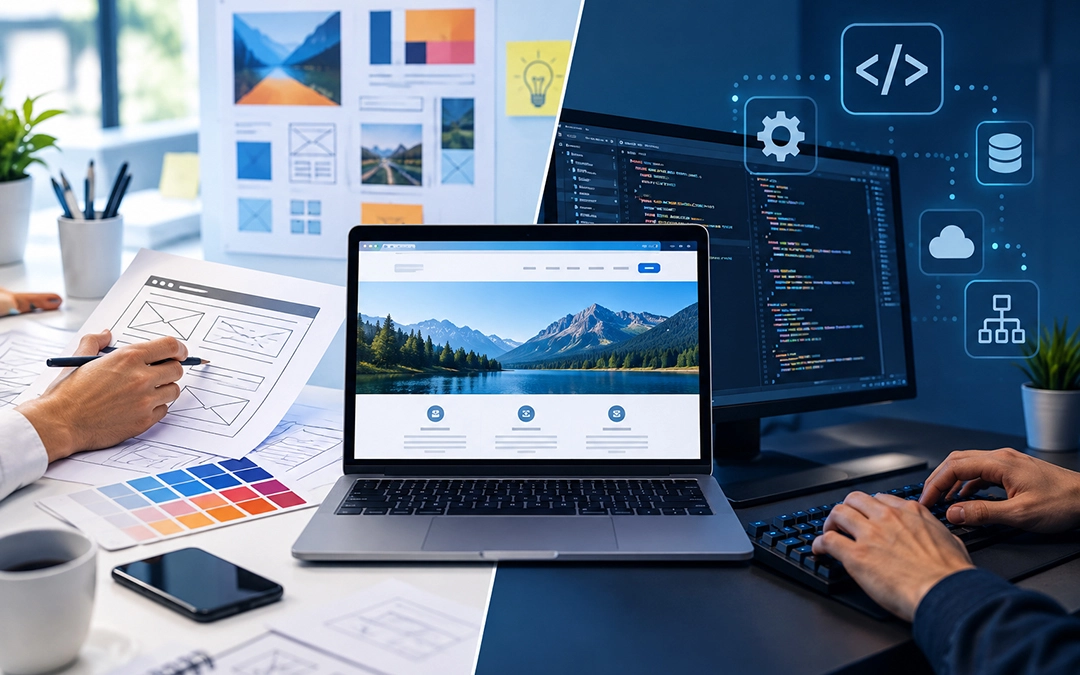
If you’ve begun searching for a web design agency to design a website for your Surrey-based enterprise, you’ve probably stumbled on the terms web design and web development, and it’s easy to believe that they are interchangeable phrases. Some agencies will use them interchangeably whereas others will specialize in only one. As an employer looking to simply create a functional and aesthetically pleasing website for your business, the difference between them might sound like jargon that has little relevance to you.
It does matter – to whom you will turn to for help, how much money you are going to spend, and whether you will receive the result that you are looking for.
This text will tell you what the main differences between web design and web development are, what each of these two terms includes, and what you should choose for your website project – web designers, web developers, or both.
The Short Answer
In one sentence, web design is the aesthetics and user experience of your website whereas web development is the functionality of your website.
Design is about how your website will look and feel, the colours, the layout, fonts, images etc and how a visitor will move from one page to the next in your website until they reach the page you need them to be at.
Meanwhile, development is the coding involved in it to make the website up and running; it’s the backend. Basically, developers “translate” the design code and make it work.
A good analogy would be building a house. The designer refers to the architect who designs the plan and determines the gaits and finishes. A developer is the contractor who constructs the house as per the plans. You’d need both and you cannot replace one with the other.
Knowing the difference makes a huge amount of difference to most small businesses that want someone to make them a website, or are looking for a company that would suit them more to build their websites would be very important.
What Website Design Actually Covers
Web design is the art and science of the web. A good web designer thinks beyond the aesthetics of a web page and focuses on factors that influence visitor behavior on the website and drive him to call for action.
Website design typically includes:
- Visual branding- refers to the color scheme, fonts, imagery style, and overall design, as well as the general appearance that reflect (or create) your brand image
- The layout and structure- mean the placement of items on a page and the information hierarchy.
- User experience (UX) –describes the ease of use and the level of convenience a visitor has while searching for the information and performing an action.
- User interface (UI) design- refers to the buttons, menus, and other interactive elements that a person can click or tap.
- Wireframes and mockups — draft versions of pages, often built in tools like Figma, that map out the site before any code is written
- Responsive design planning — making sure the layout is designed to adapt sensibly across desktop, tablet, and mobile screens
- Conversion-focused decisions — where calls-to-action go, how forms are structured, what visual hierarchy guides a visitor’s eye
A competent designer will always be focused upon the experience of the customer in their journey through your site. A beautiful site which leads the user to have to dig through layers and layers of text to ultimately find your contact details is not a good design, despite the beautiful code. It all comes down to designing with a human at the other end.
What is not encompassed by design is the functionality, that is, the working parts, such as the shopping cart, the contact form, or the administrative panel. The creation of these systems is the domain of the developer.
What Web Development Actually Covers
Once a design gets approved — usually as mockups or a clickable prototype — that’s when web development actually starts. A developer takes what the designer handed off and turns it into real, working code.
That work generally breaks down into:
- Front-end development —the HTML, CSS, and JavaScript code that a browser reads and renders to display the page and make it interactive
- Back-end development — the server-side logic and databases that power any dynamic content on the site, such as user accounts, product listings, bookings, or payments.
- CMS setup — getting a platform like WordPress or Shopify configured properly so you can go in and edit your own content later, instead of emailing a developer every time you need to swap out a photo
- E-commerce functionality — shopping cart, payment gateway, keeping inventory synced across the site
- Speed and performance work — making sure pages don’t just look nice, but actually load fast enough that people stick around
- Security — SSL, hardening the site against common vulnerabilities, staying on top of CMS and plugin updates
- Integrations — hooking the site up to whatever else runs your business: email marketing, a CRM, booking tools, analytics
- Testing — checking that everything actually works across browsers and devices before it goes live, not after
Most business owners never see this side of things, since it all happens behind the scenes — but it’s what decides whether the site actually holds up once it’s live. A design that looks good on paper can be slow, buggy forms, look great on a laptop but terrible on a phone, or even insecure and leave your customers vulnerable if done wrong.
Design gives you the polished model of what the final site should be. Development is what actually builds it. It’s the harder, more technical half of the two — which is exactly why so many business owners run into trouble picking a company that’s light on real development experience.
Why Most Small Businesses Need Both, Not One or the Other
Here is where all the confusion, and most often the wasted budget, begins. Entrepreneurs try to find “a web designer” or “a web developer” as if it is an either/or decision. In fact, any competent business website will require both skill sets in execution, be it one developer wearing two hats, a small team, or an agency that has both disciplines under one roof.
Think about what happens when one only gets half the equation:
Design without Development
Design without development leaves you with a portfolio of static images or a Figma file – not a website. Something still needs to be built somewhere, made responsive, connected to a CMS, and deployed to a server. Without a developer, your beautiful design only exists as a picture of a webpage.
Development without design leaves you with a technically competent but often bland, unusable, and ineffective website. Developers are not trained to make strategic visual and UX decisions about what will make your Surrey-based renovation company stand out to would-be customers over the generic-looking competitor down the road whose website they stumbled on by accident. The developer’s job is to make things work, not to make strategic design decisions about how to make websites “convert.”
Why do you think that hiring a designer and developer separately (as freelancers) would be a disastrous decision?
Designers can come up with impossible-to-realize or too-expensive-to-consider ideas. In contrast, developers risk compromising the code without the designer’s knowledge. While cooperating with an outsourcing team, it is challenging to avoid the rush as two persons, who know nothing about each other, should work at the same time and pass information from one to another.
What’s the real-world conclusion for most small/medium-sized Surrey businesses (contractors, medical clinics, retail, professional service firms, etc.)? The conclusion is usually that you need both a designer and developer – working together – to successfully launch a new website or make fundamental changes to an existing one. It may be one person (a hybrid freelancer), though, or a small agency that works on an integrated design/build basis rather than a design + development hand-off basis.
How to Tell Which One Your Project Actually Needs
That said, there are situations where you genuinely only need one side of the equation — at least for now. Here’s a practical way to figure out where your project actually sits:
You probably only need design if:
- You already have a fully built, functioning website and just want a visual refresh
- You’re working with a website builder (Squarespace, Wix) where the “development” is largely handled by the platform, and you need someone to make it look professional
- You need marketing assets — social graphics, landing page mockups, brand visuals — rather than a functional build
You probably only need development if:
- You already have an approved design or brand guide and just need it built
- You need a specific technical feature added to an existing site (a booking system, a custom integration, a performance fix)
- You’re a technically capable business with in-house design resources but no coding capacity
You almost certainly need both if:
- You’re building a new website from scratch
- Your current site is outdated in both appearance and function
- You’re launching e-commerce or need custom functionality your current site can’t support
- You want a site that reflects your brand and performs well — loads fast, ranks on Google, converts visitors into leads or customers
If you’re not sure which category you fall into, that uncertainty is actually useful information. It usually means you need a starting conversation with a web development company in Surrey that can assess your existing site (if you have one) and tell you honestly whether the fix is cosmetic, structural, or both — rather than a freelancer who will only ever tell you that their specific skill set is exactly what you need.
What This Looks Like at Technoz
At Technoz, we don’t split clients into “design people” and “development people” and hand them off between departments with no communication. Every website project we take on for Surrey businesses runs through both disciplines as one connected process, because we’ve seen firsthand how much gets lost when design and development happen in isolation.
Here’s how that plays out in practice:
- We start with strategy, not screens. Before anything is designed, we talk through what the site actually needs to accomplish for your business — more phone calls, more bookings, more online sales — so every design decision downstream is working toward a measurable outcome, not just aesthetics.
- Design and development happen in the same room. Our designers know what’s technically realistic to build, and our developers understand the intent behind every design choice, so nothing gets watered down or reinterpreted somewhere in the handoff.
- You get a site that looks right and runs right. That means responsive layouts that actually work on a phone in someone’s hand, forms that reliably land in your inbox, pages that load quickly, and a CMS you can actually use to update your own content without calling us every time you want to change a phone number.
- We build for Surrey businesses specifically. Whether you’re a local contractor, a clinic, a retailer, or a professional services firm, we understand the local competitive landscape and build sites that are meant to perform in local search, not just look good in a portfolio.
If you’re trying to figure out whether your project needs a redesign, a rebuild, or both, that’s exactly the conversation we’re set up to have. Reach out to Technoz and we’ll take an honest look at what you’ve got — and tell you straight whether the problem is how it looks, how it works, or a bit of both.