
What LLM integration really means
A large language model AI (LLM) is an artificial intelligence language model trained on extensive data to understand, generate, and respond to natural language queries. LLM uses state-of-the-art machine learning algorithms, including deep learning and transformer-based neural networks, to achieve proficiency in natural language processing and production. Some typical applications of large language model AI include responding to questions, content creation, language translation, document summarization, coding, and other natural language processes.
ChatGPT, Claude, Gemini, Llamas, and Mistral are some of the most popular large language models companies use to automate processes involving language. Using these models, you could add intelligence to your website, application, customer support system, or business process to scale customer engagement and drive revenue growth. Large language model AI could help you automate and optimize your operations to deliver best-in-class customer service and maximize profits.
LLMs for Customer Service and Support
Large language models (LLMs) are set to revolutionize customer service by enabling businesses to provide timely, relevant, and personalized assistance to their customers 24/7. Unlike traditional chatbots, LLMs can understand and interpret natural language and respond appropriately by answering questions, solving problems, guiding the customers through processes, and escalating issues to human representatives when needed.
The applications of LLMs in customer service are numerous and include websites, apps, help desks, live chats, and messaging platforms, among others. By using AI to communicate with customers, businesses can provide multilingual support, quick responses, consistent service, and round-the-clock availability. Moreover, it reduces the workload of support teams by handling simple and repetitive queries, thereby allowing human agents to focus on complex and nuanced issues. Thus, businesses can benefit from large language models by being able to offer high-quality customer support that drives engagement and loyalty.
The most common LLM integration patterns
Most practical implementations of large language models (LLMs) being used today have been trained using only a handful of common use cases. One of the most common ways organizations are using LLMs is content generation. Using prompts, companies request the AI to generate content for them ranging from emails, blog posts and articles, product descriptions, and whitepapers. Using LLMs for content generation leads to massive time-savings compared to human writing.
Another dominant use case is data classification and information extraction – using LLMs, companies classify and extract structured information from thousands of customer requests, feedback, contracts, or other data sources. A third common way businesses are using LLMs is through retrieval augmented generation (RAG). Using RAG, companies enable their models to query an internal knowledge database to provide answers and information relevant to the company’s data.
Some companies are already utilizing AI agents that can perform complex tasks with human-level precision. These AI agents can perform tasks such as interacting with external APIs, CRMs, databases, search engines, and other business applications. AI agents that can perform such tasks open up a world of possibilities in automating business processes, requiring minimal human input. Due to the differences in requirements such as processing power, speed, accuracy, reliability, and other factors, some approaches may be better than others for different applications. While simpler tasks such as categorization may be performed using basic models, complex AI agents capable of performing complex tasks such as strategic planning may require more powerful models and additional training to achieve reliable results.
Choosing the Right LLM Integration Architecture
The successful implementation of a large language model (LLM) is determined by the design architecture, not the model itself. Therefore, before choosing which model is best for a particular company, some criteria must be established, such as the data location, users, and response time. The simplest way to implement an LLM is to make an API call for a general-purpose model and a streaming API for better results. Those companies that have a higher volume of requests and/or regular requests in advance can process them in a background stream. Finally, more complex applications usually use orchestration tools to delegate specific tasks to different models, making the system smarter and allowing it to perform more functions. In addition, when implementing this technology, companies must decide how and where to deploy it. For most firms, the easiest way to get started is a cloud-based API. A company would choose between a private cloud and a local or on-premises version to ensure security. Thus, there are several ways to implement large language models, each of which requires attention to certain factors.
Connect the model to your data with RAG
The most successful implementations of LLMs go beyond the information contained in the initial set of training data for the model. The way to accomplish this task is to use Retrieval-Augmented Generation (RAG) to give the language model (LLM) access to the latest information that is relevant to a business, such as documents, customer support tickets, product data, knowledge base information, and other user data.
There are several important steps required for developing an efficient RAG solution, including data collection, preparation, document segmentation, and the creation of embedded vectors. These vectors must be stored in a vector database, where the most relevant documents will be retrieved and ranked according to their degree of similarity to the input query. Following that, the query and response must be fine-tuned, and the prompt must be prepared and sent to an LLM for completion. To find the most efficient RAG model, it is essential to compare various embedding and retrieval approaches using test queries. To increase the quality of answers and boost the confidence of users in the new solution, it is also helpful to implement additional helpful functions, such as smart segmentation, relevance filtering, and citing specific sources that provide the required information.
Handle latency, cost, and reliability from day one
LLM-based applications have unique characteristics that should be taken into account when comparing their performance to conventional software powered by APIs. The former requires specific considerations to achieve satisfactory results because their responses may take considerably more time to be processed and produce undesirable financial outcomes if not properly regulated. Thus, to guarantee that the utilization of LLM stays efficient and does not cause any adverse outcomes, such technology should be implemented correctly by, for example, applying response streaming to make interactions appear faster and using caching to minimize repeated queries. Additionally, the reliability of the system should be reinforced through the use of various methods, including model backups, response timeouts, retries, and failure protections, among others.
Since the application of LLM typically demands substantial costs, it is essential for companies to ensure that their expenditures are aligned with the set budgets. The aforementioned goal can be achieved through tracking token consumption, response time distribution, and request statistics, among others, to identify underperforming areas. Moreover, establishing quotas, viewing budgets, setting up alerts, and choosing the most appropriate models for specific tasks can contribute to cost reductions. Notably, the majority of modern LLMs possess diverse capabilities and infrastructures that allow them to route requests from less capable but cheaper models to advanced and expensive alternatives depending on their complexity. As a result, organizations can benefit from the mentioned approaches to leverage the unique advantages of LLMs without spending too much on their implementation.
Security, privacy, and compliance in LLM integration
Deploying an LLM involves exposing it to sensitive information either through a third-party provider or internally. As a result, one cannot neglect the importance of ensuring its security from the design phase. The most crucial elements to consider are input validation, response monitoring, avoiding exposure of sensitive information, removing personal data, and preventing prompt injection. For organizations planning to serve multiple clients, whether through SaaS or other means, it is vital to ensure data isolation at the infrastructure level, only providing access to the required information for each customer.
Moreover, an organization must consider compliance requirements which are vital in the selection process of an LLM. Not only does it differ from industry to industry, but it also requires different approaches and additional infrastructural support. For example, healthcare applications have different requirements from financial ones, where the former focuses on patient information security while the latter emphasizes audit trails, regulatory compliance, and risk management. Finally, designing an application around security and compliance principles helps an organization establish an efficient and trustworthy LLM implementation strategy that can scale exponentially.
Evaluate the integrated system, not just the model
A language model which scores highly on standard benchmarks is not necessarily a good performer when deployed in practice. The key to building an effective LLM application is the development of robust evaluation practices which capture user intent, information recall, accuracy, response format, and efficiency at both the system and business logic level. A strong evaluation protocol will make use of real-world example queries, expected response types, and difficult edge cases from production data.
The process of testing and retesting applications which use predictive models should never be a one-time task. As prompting, internal models, retrieval systems, and overall system logic are updated, existing evaluations should always be used to confirm improvements in practical performance. More automated approaches such as evaluation modules or custom AI auditing can assist human analysts in testing large numbers of responses, but hands-on analysis of challenging queries will always be necessary. By failing to maintain and improve evaluation rigor, organizations risk seeing gradual declines in accuracy due to shifting underlying data distributions, model capabilities, and user needs.
Build versus buy: when to use platforms versus custom integration
The rise of the LLM ecosystem has created a multitude of offerings that seek to abstract away the complexity of data retrieval, agents, and applications. While such platforms enable teams to iterate faster and reduce time-to-market for an initial prototype, they also introduce a set of risks and challenges. One should be wary of power dynamics imposed by a particular ecosystem, reduced flexibility, and potential pitfalls in meeting particular data needs and security or regulatory requirements.
When designing one’s own LLM application, it is reasonable to start with a direct API integration for a use case of choice to explore and prioritize requirements. It will also help to standardize frequently occurring patterns and procedures and document them for later reference. In combination with direct API calls, one can use existing frameworks to accelerate development and improve quality, such as LangChain, LlamaIndex, or Vercel AI SDK. Nevertheless, they are merely tools that should supplement one’s understanding of the data and engineering processes rather than dictate them. The choice of a particular framework or tooling is less important than the quality of data, context, and security, rigorous evaluation, and the ongoing enhancement of existing processes.
How to start your first LLM integration
When designing an LLM solution, it is better to start big but think small, choosing one particular user task that can be solved by a language model. You should also decide how you would know if the task is done correctly, define what information the model should provide, and what data you would give the model as input. You should also design the system and develop a reliable way of retrieving information for the model if the information is specific to your company or product. Then, you should choose the best model for your solution based on its accuracy, speed, and cost by comparing different hosted solutions.
Before launching an AI functionality for the general public, it is also necessary to build production-level infrastructure, design security audits, responses, caching policies, and performance monitoring. To design a working prototype, you need to follow a certain set of processes that allows you to gather enough evidence to determine the best course of action. This way, you would be able to iteratively experiment and optimize your solution. In other words, the integration of large language models is only the beginning of the development, which then focuses on learning and testing the technology.
LLM Integration Guide: How to Add ChatGPT, Claude, and Gemini to Your Apps
AI powered applications such as ChatGPT, Claude, Gemini, and others are disrupting the application development landscape and changing how businesses build software to serve their purposes. These Large Language Models (LLMs) enable apps to understand what users request, come up with relevant responses to queries, automate mundane tasks, and provide valuable content. Nonetheless, making an application AI-capable involves more than just plugging in an AI model. In addition to understanding the API interface of the language model of choice, businesses must also develop methods to prompt the model while fine-tuning the response and managing costs. This essay provides an overview of the fundamentals of building apps that leverage large-scale language models.
Major LLM Providers
Consider the differences in features, cost, and application focus. Top AI providers offer a range of language models that solve different problems and have unique advantages.
Leading firms provide powerful tools for businesses and developers. The choice of the most appropriate large language model (LLM) depends on specific use cases, data sensitivity, costs, and performance needs.
OpenAI provides powerful language models which can be applied in most cases, offer good API availability, and are well-documented for developers. Its GPT-4 version is great for complex tasks, coding assistance, and creative writing, while GPT-3.5 is a more affordable option ideal for routine operations. However, high-level models may involve substantial costs in heavy use.
Anthropic has developed Claude – a model which allows performing the most involved tasks (e.g., analyzing long documents). It has good safety mechanisms and is suitable for users who want to process large volumes of information in a reliable environment. It is also relatively inexpensive and thus beneficial for businesses and heavy users.
Gemini from Google is a multilingual, multi-platform model which is great for building applications with complex instructions. It is suitable for developers since it is compatible with Google’s ecosystem and allows creating products which process and analyze various types of data (e.g., images and text). However, its performance level is moderate given the relatively high cost.
Llama and Mistral are open-source models which allow building reliable solutions for specific tasks. They are beneficial for businesses which want to avoid using third-party APIs to process sensitive data. However, it may be challenging to use these models without profound technical expertise since they require infrastructure, maintenance, and expertise to operate.
Getting Started: API Setup
OpenAI Setup and Basic Usage
OpenAI’s API offers a range of possible use cases for developers who want to leverage the company’s AI technologies. This involves a relatively easy setup process, which typically requires generating an API key and installing the client library. The latter is used to send requests, which takes the form of a chat between the user and the AI model. These involve system and user messages, with the former instructing the model on how to behave and the latter providing the input data.
To use the API, developers usually have to set up a client, prepare the necessary messages, and send them to the chat completion endpoint. By using this technology, programmers can rely on the company to handle the complex computations involved in training the model while they build their applications.
Anthropic Claude Setup
Anthropic’s Claude API is integrated similarly to other large language models with additional implementation particularities. The access to the API is provided by the API key, and requests are sent to the Claude API through the messages API. The request setup includes input message specification and response parameters such as output limit, and the response itself is organized in a specific response structure.
Claude offers consistent documentation and predictable behaviors in its API, enabling developers to design and maintain applications effectively. Another advantage is the possibility to work with a significant context size; thus, the API may be employed in applications related to long conversations, documents, research, and knowledge management.
Google Gemini Setup
Google Gemini’s integration to the platform is realized through the application of Generative AI paradigm. The former requires developers to define a certain model and apply generation to it in order to obtain AI responses. Such an approach is beneficial from the perspective of businesses that integrate Google Cloud into their operations since it offers flexibility.
Gemini can also be integrated into applications with the help of multimodal features that enable AI to process and comprehend various types of data like text and images. As such, it is suitable for organizations that seek to create an interactive experience for users while also relying on the technology to analyze outputs in terms of different types of data.
Prompt Engineering Basics
Understanding Prompt Structure
Effective prompts are constructed using clear instructions to guide the response generated by the artificial intelligence. The system messages define the instructions, rules, and expectations of the model. They establish the role, behavior, level of knowledge, and communication style that the AI should adopt to effectively respond to user queries.
Meanwhile, the user messages contain the questions, tasks, or instructions given to the AI.They need to be clarified to achieve better results because they will provide the model with the information, context, examples, or guidelines necessary to complete the requested task.
Prompt Engineering Techniques
I think there are several ways to get better results from AI, the first one is to make specific prompts. Instead of writing “summarize this email”, try using something like “summarize this email in three bullet points, stating the main action items”. The more detail and specification you add, the better results you will get.
Another great trick is to use few shot learning, basically, you give an example of what you want, and the AI will give you an example of what it will produce. It works really well to showcase what kind of structure you want the response to have.
When you need an accurate answer, you should ask for a chain of thought prompting. It will help break down the thought process and make it more organized so that the answer is more accurate.
The last thing I want to say is that adding constraints will modify the results according to your specifications. You can write down what you want the response to include or exclude, how long it should be, how it should be structured, etc.
Common Integration Patterns
Pattern 1: Chatbot Implementation
Chatbots present a unique challenge in that they must maintain a conversation history to give an appropriate response. This is achieved by first storing this conversation history somewhere and then, for every user message, appending the message to the history, calling the LLM API with the entire history, and saving the response from the LLM into the history. This general approach allows to implement an effective chatbot which maintains appropriate context between messages.
In context of implementing such chatbot, it is neccessary to manage the conversation length to ensure that the entire conversation history fits into the tokens limit of the LLM being used, gracefully handle exceeding it, and implement appropriate logic for when the chatbot is unable to assist.
Pattern 2: Text Generation
Text generation solutions employ Large Language Models to generate various types of documents, such as emails, reports, documentation, and articles. This process requires designing prompts that specify what type of paper should be generated, its tone, style, target audience, and additional requirements. In turn, based on these instructions, the application produces high-quality text that meets the user’s expectations and allows creating the necessary documents in a timely and efficient manner.
It is essential to note that several recommendations guarantee the possibility to produce the most relevant text generation results. Firstly, creating effective prompts is critical, as it determines what information the model should generate. Secondly, providing the algorithm with examples facilitates the ability to comply with the user’s guidelines and attain the desired outcome. Finally, choosing the appropriate model is also significant, as it involves the possibility to balance quality, speed, and cost. For instance, a more prominent model produces better results but requires a higher cost per request, while a smaller model offers reasonable quality at an affordable price.
Pattern 3: Data Extraction
Data extraction works by utilizing Large Language Models (LLMs) to transform unstructured data from text into some form of machine-readable information. This process typically involves supplying the text for data extraction, specifying the desired information, and defining the target format (e. g. JSON). The information extraction using LLMs requires context and language understanding to recognize patterns and connections in the text, thereby extrapolating different representations of the same information.
The key factors for successful data extraction are precise description of information to extract, specification of target structure and validation of extracted information. In turn, JSON representation of extracted information allows easy utilization in some other downstream processes or applications.
Pattern 4: Classification
Classification utilizes Large Language Models to classify a given text under one or more preset categories according to their content. The prompt requires submitting the text to be classified, specifying the categories with their descriptions, and asking to classify the text under the most suitable category. A low temperature is recommended to ensure consistency and repeatability of results due to its deterministic nature.
The prompt should include category labels, classification criteria, and examples of each category if available. This will allow the model to differentiate between similar categories and yield better results. The prompting pattern is commonly applied in sentiment analysis, topic classification, spam detection, ticket routing, and other computer-related applications where a reliable and consistent outcome is desired.
Cost Optimization
Understanding LLM Costs
LLMs pricing is usually based on the number of tokens, not words, with one token approximately equal to 0.75 of a word. However, it is better to refer to them as units of information since different languages and symbols have different token sizes. The amount of tokens directly impacts the cost; more sophisticated and complex LLMs have higher prices due to their complexity and the increased resources needed for their operation.
The two types of tokens, namely input and output, should be kept in mind while using LLMs since they both affect the final price. The former implies the number of tokens entered into the model, including the prompt, instruction, and context data. The latter refers to the number of tokens the model produces as an output. Therefore, it is essential to reduce both input and output tokens when seeking to decrease costs since the former involves additional information, such as instructions and context, not included in the final answer.
Cost Optimization Strategies
Optimize LLM Usage Essay
The critical point in optimizing large language model (LLM) usage is choosing the right model for the task. For example, if an application requires generating text, summarizing, classifying, or extracting information, it is better to use a small or medium model since large ones are usually more expensive. Thus, it is vital to identify the level of complexity of the task and leave the complicated problems to bigger and more advanced models. Another essential optimization method is reducing the response length, which allows saving tokens and, consequently, money.
The key to this approach is to set a specific length limit to the response so that the model is not forced to produce irrelevant or unnecessary text. Moreover, it is critical to cache repetitive responses to avoid generating the same text multiple times. The application will become faster, and the business will save on API calls because the same request will not be sent to the LLM again. It is also worth noting that LLM API requests are independent, so grouping similar prompts into one will make the application more efficient and organized. This method does not reduce the token amount but helps manage the request better and makes the processing faster. Lastly, streaming responses should be considered as the optimal way of delivering text to the user. Since the text is not sent as one chunk at once, the application seems more responsive and faster. However, it is essential to understand that streaming does not reduce the token amount or the cost of the API call.
Error Handling
Handling Rate Limits
Rate limits are imposed by the LLM service providers to limit the number of API requests or tokens processed within a given time window. In case of crossing this threshold, your request will result in a rate limit error, which means that it should be retried after some time. An appropriate way to handle rate limit errors is to implement a retry logic with exponential backoff to increase the wait time between consecutive requests.
It is essential to design a robust retry mechanism with an appropriate number of attempts, exponential backoff, and comprehensive error handling. Otherwise, an unreasonable number of requests sent to the API on retry will cause even more errors, increasing the load on the server and potentially triggering a circuit breaker. On the other hand, if retries fail, it is necessary to provide an appropriate response to the user, for instance, by showing an error message or putting the request into a retry queue. Alternatively, if there is a possibility to fulfill the request in another way, this option should also be explored instead of making further API calls.
Handling Invalid Responses
A response from an LLM may lack the expected structure (e. g., JSON). To avoid malfunction, it is essential to ensure validity before attempting to use the response. If the application can handle it, malformed responses should be corrected or recovery should be attempted automatically. Otherwise, error messages should clearly state the issue and provide useful context. Invalid responses from LLMs should be logged for debugging, and proper fallback mechanisms should be initiated if the response cannot be used due to validation failures.
For the case of applications expecting a JSON response, it is advisable to initially check whether the response is a valid JSON. In cases where additional information is provided alongside the JSON response, an attempt should be made to extract the JSON part from the response. If these measures fail, the application should output error messages, log the event for debugging purposes, and invoke fallback procedures, including, but not limited to, retries or user notifications.
Handling Timeouts
API timeouts can happen for various reasons, including too long requests due to network delays, high server load, and slow model replies. The right way to handle timeouts is to set timeouts to reasonable numbers, catch them, and implement fallback mechanisms so that the application can recover from the problem. It is also essential to log timeouts to analyze potential issues and improve the application’s reliability.
The timeout value should be long enough to allow for a successful request but not too long to waste the user’s time. If the timeout signal occurs, the application can retry the request or inform the user about the delay and suggest trying the operation later. An appropriate timeout value combined with proper error handling and logging will ensure the application works correctly, providing end-users with the best experience.
Security Best Practices
Protecting API Keys
API keys are a critical asset which require all due measures to ensure their confidentiality. A company should never store them in the source code or check them into a repository. Instead, use environment variables, secret management tools, or protected configuration files. This practice ensures that API keys are not exposed publicly and reduces the risk of theft, as only authorized users will have access to them.
Moreover, the company should use various security practices concerning API keys. First, make sure to store them as environment variables while working locally and as secrets in repositories while working remotely. Second, rotate keys periodically and immediately upon suspicion of compromise. Finally, limit access to API keys following the least privilege principle and monitor their usage for unauthorized requests. Such measures will help an organization mitigate the adverse aftermath of stolen API keys.
Validating Input
Input validation is an important security and reliability measure that ensures that only the correct and well-formed data is sent to the LLM API. The application should validate the input length, sanitize potentially dangerous content, and enforce business logic constraints to ensure that the request is processed correctly and safely.
The input validation process is critical for several reasons. First, it helps prevent prompt injection attacks by ensuring that the input does not contain any malicious code or instructions. Second, it reduces the number of invalid API requests, which can waste resources and negatively impact the application’s performance. Finally, input validation helps the application to handle edge cases gracefully and provide a better user experience.
Monitoring Usage
Usage monitoring is crucial for the proper functioning of any LLM-based application. It is necessary to ensure the system’s efficiency, security, and cost-effectiveness. The critical parameters that should be monitored include the number of requests, tokens, costs, response time, and error rate. By evaluating these statistics, one can detect anomalies, optimize the system’s performance, and identify underutilized areas.
The regular analysis of the aforementioned parameters allows the system’s owners to control costs by eliminating underperforming processes and ensuring the absence of any unauthorized activities. Moreover, the consistent monitoring of LLM performance can help identify issues and provide a solid foundation for any optimization or decision-making process.
Implementing Rate Limiting
Client-side rate limiting plays an important role in managing the API usage of an application. Imposing rate limits on model queries can prevent the application from incurring large costs by accidentally exceeding the rate limits of the service providers. This method is essential to ensure that the utilization of the service is optimized and distributed evenly, considering the API restrictions, users’ demands, the application’s needs, and costs. The choice of which rate-limiting strategy to implement depends on the specific application’s requirements, traffic patterns, and budget constraints, among other factors. However, in all cases, the strategy must be designed to balance the needs of the users and the costs and capabilities of the service.
Production Considerations
Caching Strategies
Caching common queries is one of the ways that help reduce the API usage, the cost, and the response time of the large language models (LLM). It could be done by storing the results of regular or recurring questions and using them for subsequent identical requests. However, it should be done correctly so that the application continues providing the accurate answers when required. First, the queries that are the most frequent ones should be sorted out. Then, the cache keys should be properly decided upon. Finally, an efficient invalidation mechanism for the cache should be created. Those keys that are less frequent or are not used at all should either be moved to a different cache or removed. Additionally, there is another rule for caching that depends on the frequency of changes. The more often the data changes, the shorter should be the cache’s lifetime.
To sum up, when implemented properly, caching common queries will reduce an application’s API usage. As a result, the application will provide better performance for its users. At the same time, the query’s response should not become outdated. Thus, the response’s freshness should be balanced with the cost and API usage.
Async Processing
Asynchronous processing can be utilized in an application to improve its performance, which is achieved by allowing the program to handle multiple requests at once instead of sequentially. It is particularly useful for programs which perform bulk operations, process multiple items at the same time, or handle a high number of requests since it reduces waiting time.
Therefore, asynchronous processing should be used in applications which need to accomplish these tasks in order to improve performance. However, it should be noted that async processing needs proper async framework/library, limits the number of concurrent requests to avoid overload, and handles errors which occur during concurrent operations appropriately to effectively utilize asynchronous requests in a program.
Monitoring and Observability
Production monitoring is crucial for the success of most LLM applications. One should consider implementing dashboards and tracking the critical metrics such as API response time, error rates, tokens, API requests, and cost. It allows one to stay on top of the performance of his or her model, spot any issues and address them before they cause serious problems, and optimize the performance and expenses.
The monitoring tools should also provide informative dashboards so that one will be able to make data-driven decisions concerning his or her application. This way, one will have a good understanding of how his or her application works, which will allow them to manage their costs, guarantee reliability and performance, and maintain a positive experience for their end-users.
Fallback Strategies
Fallback strategies are essential in designing applications featuring large language models (LLMs) because they allow the software to recover from errors and provide continuous service to the user, even when one or more of the used API endpoints become unavailable, misbehave, or fail completely. They help in cases when it is preferable to utilize an alternative model, respond with a default answer, reduce the scope of processing, or escalate the query to humans for review. The fallback functions should ensure that the software provides valuable service to the user whenever possible, even when some of the designed reliability and resiliency mechanisms fail.
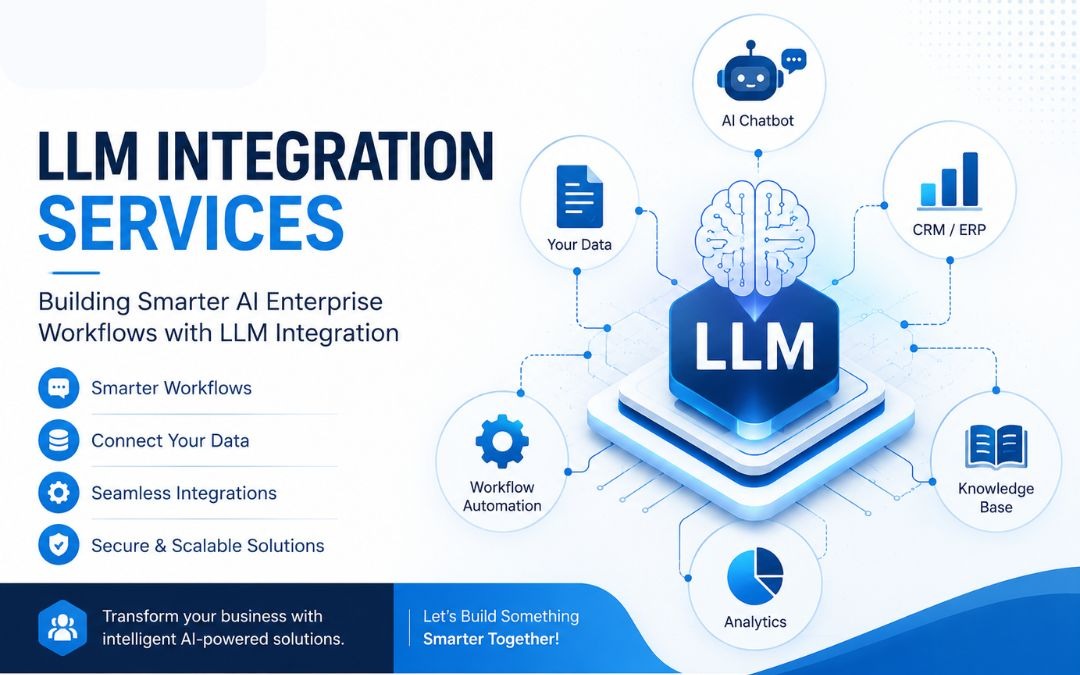
Building Smarter AI Enterprise Workflows with LLM Integration
Many companies have already adopted LLMs, but the way of working has not changed. They still perform repetitive manual tasks and spend a lot of time searching for the right information in different applications before being able to take action. This challenge, among others, is what makes the connection between AI and the actual business processes so difficult to achieve.
An LLM can generate smart answers and suggestions; however, the real value is created when the intelligence is embedded into the relevant systems and processes. For tech leaders, it has become a priority to empower their processes and systems with AI while ensuring that it works in tandem with other tools like CRM, ERP, knowledge bases, approval chains, and more.
LLM integration services enable companies to turn experiments with large language models into enterprise-grade automated solutions. The advantages of such solutions include faster access to information, reduced manual work, increased collaboration between stakeholders, and enhanced decision-making processes.
This blog will demonstrate how companies can benefit from connecting LLMs to their systems, data, and processes to achieve substantial improvements in their operations.
Why Enterprise Workflows Need More Than Standalone AI Tools
Most companies started experimenting with easily adopted AI like summary, content creation, research assistance, and meeting transcription. These areas allow individuals to get more done, but they do little to fundamentally change the way work gets done across departments and functions. Recent industry surveys show that most companies are using generative AI in superficial ways that rarely improve core processes. The issue is not that individual AI tools have limited value; the problem is that the value too often stops at the individual level, failing to permeate the broader environment where work gets executed.
At the individual level, tools like copilots and AI assistants are tremendously valuable. But for enterprises, leveraging large language models (LLMs) should extend far beyond wowing knowledge workers with time saved on individual tasks. That’s because individual productivity gains provide limited benefit if the broader system and processes are not optimized and re-engineered around AI-driven insights.
When companies deploy AI as copilots or assistants within established systems, there is tremendous opportunity for the models to become deeply embedded in the workflow by understanding the context of the end-to-end process, policies, and roles. This approach offers much more value than allowing people to copy and paste information between programs, making decisions, and managing disconnected systems. It transforms how work gets done by embedding AI as a true enabler of enterprise-scale change and operational excellence and workflow transformation.
What LLM Integration Services for Business Enable at Enterprise Scale
LLMs deliver real business value at scale when they are connected to the systems, data sources, and governance controls that define everyday operations. LLM integration services for business transform general-purpose models into enterprise-ready capabilities that can understand organizational context, follow workflow requirements, and support decision-making within secure and approved environments.
Successful large language model enterprise integration focuses on connecting AI capabilities with existing business processes while maintaining control, security, and reliability. Key capabilities include:
1. Retrieval-Augmented Generation
Retrieval-Augmented Generation (RAG) is an innovative approach that connects LLMs (Large Language Models) with enterprise information sources. It enables the model to base its answers not only on the data it was trained on but also on relevant external information from reliable sources such as documents, databases, policies, and knowledge repositories.
Business value: RAG enables higher quality and more accurate responses for enterprise use cases, including internal search, customer service, regulatory compliance, and AI-powered knowledge management. In contrast to traditional LLMs, RAG responses are grounded in facts from trusted sources, providing greater accuracy and reducing hallucination risks.
2. Custom Model Fine-Tuning
LLM fine-tuning for business represents the adaptation of a model to reflect the specific language, processes, tasks, and domain needs of an organization. It is critical in scenarios where businesses seek to establish reliable behaviors and specialized responses for particular application areas that cannot be sufficiently addressed by prompt engineering, retrieval-augmented generation (RAG), or governance measures.
Business value: The fine-tuning process enhances models’ capacity to meet enterprise-level application needs by aligning them with internal specifics, language patterns, and specialized functions, thus improving relevance and performance.
3. Workflow and System Integration
The integration of LLM (Large Language Model) represents the connection of AI capabilities with enterprise applications, such as CRMs, ERPs, service management systems, document management systems, or approval processes. In other words, the application of large language models in real business processes allows you to organically embed AI in the daily work of an employee who uses enterprise software.
Business value: The integration of LLM into enterprise software enables real use cases of AI in a business: implementing summarized responses to service requests, creating updates for customers, extracting information from documents, automatically routing requests, and much more.
4. Tool and Function Calling
Tool and function calling provides an LLM the ability to interface with approved APIs, enterprise applications and business systems to perform a specific action. Rather than simply outputting a response, the model can securely execute a pre-defined action, including opening cases, updating CRM records, pulling order details, checking policies or driving other business processes.
Business value: Using tool and function calling enables the LLM to do more than just provide information. It allows the AI to participate in the business process, interacting with controlled functions within approved systems to help drive productivity and efficiency whilst maintaining governance and security
5. AI Agents and Autonomous Workflows
AI agents enable LLMs to perform designated tasks within a predefined business process that often require reasoning, accessing permitted external tools, data, and systems, acting on required information, and coordinating end-to-end process flows while remaining within predefined constraints and rule sets.
Business value: AI agents enable sophisticated automation solutions powered by large language models that deliver increased efficiency by reducing human handoffs and enabling end-to-end process orchestration while still being able to comply with governance and control requirements. Such automation solutions can be applied across a wide range of functions from customer service, finance, HR, to procurement and operations.
6. Governance, Security, and Guardrails
Enterprise LLM deployment needs to have tight governance and control mechanisms to ensure that they are used safely and effectively. There is a need to develop policies that will govern users, processes, audit trails, data, human supervision, and outputs.
Business value: Effective governance enables businesses to achieve secure and verifiable business processes while at the same time adhering to their obligations in terms of risk management, data management, regulatory compliance, and human oversight.
7. AI Gateways and Observability
AI Gateways and observability solutions empower enterprise leaders to gain insights into the usage of large language models, costs, performance, latency, and reliability. This capability helps understand the impact of artificial intelligence on an enterprise after implementation.
Business value: Observability assists in implementing AI integration best practices by enabling better control of costs, quality of responses, performance, and reliability. In other words, with enhanced observation of large language model usage, enterprises can fine-tune and optimize their applications constantly.
In combination with gateways, observability tools allow turning a standalone LLM solution into an integral part of enterprise software. In this way, the actual value of enterprise AI appears, as intelligent agents can securely operate with trusted data following specific rules while ensuring business processes’ integrity, control, compliance, and governance.
Where LLM Automation Solutions Create Workflow-Level Value
LLMs will deliver the highest impact when reducing the friction in processes that are critical to the everyday operation of a business. The most impactful applications will be in automating routine requests, searching through disparate data sources, performing manual reviews, or coordinating across different systems.
The most valuable uses of LLMs will be in automating processes, improving access to information, accelerating decisions, and coordinating across different systems. The most valuable applications will be in automating high-impact processes where the need for faster or more efficient execution is most urgent.
1. Document-Heavy Operations
Many enterprise processes are currently driven by manual and time-consuming reviews of invoices, contracts, claims documents, reports, and policy letters by employees. Large language model (LLM) automation can accelerate and improve these processes by extracting relevant information, summarizing, classifying, identifying, and routing documents to the appropriate downstream workflows.
The key is to recognize that LLMs should not replace human expertise and judgment in areas that require it, but rather to harness their ability to drive down the time spent on these processes by performing mechanical tasks such as document searches, cut-and-paste data entry, or report formatting.
For enterprise leaders, the appeal of these technologies is clear: the combination of faster processing, increased accuracy, and higher overall efficiency that they bring to document-intensive operations.
2. Intelligent Service and Lead Routing
Service, sales, and support departments waste considerable time dealing with requests in various forms and channels such as emails, web forms, chats, CRM entries, and tickets. Each of these channels may contain some information relevant to the customer’s request, but the information is often scattered across different software and difficult to navigate.
LLMs for CRM and ERP can help manage all incoming requests by classifying the intent, extracting relevant history, updating records, and suggesting the next steps automatically, thus streamlining the process, improving the experience for customers and employees, and reducing the context-switching overhead for service representatives.
3. Software Delivery and DevOps
Engineering teams today grapple with an overwhelming volume of data that can make getting context around incidents, changes in the system, and the impact on software hard to untangle. LLM automation can help by summarizing incidents, contextualizing technical errors, suggesting test cases, and finding connections between tickets, code, and system changes.
The value is considerable to teams responsible for large-scale platforms and applications. The intent is not to replace engineering teams or judgement, but rather to free them of repetitive tasks by accelerating analysis, shortening mean time to resolution, and providing context needed to move quickly and confidently in high stakes environments.
4. Data Transformation and Knowledge Synthesis
Enterprise data is rarely siloed in one centralized repository. It has to be mined from disparate sources such as excel sheets, reports and presentations, emails, dashboards, documents, and various other system exports – information that isn’t always immediately accessible or easy to consume. LLM automation can extract this information and turn it into digestible summaries, business insights, and reports.
This makes individual contributions of human intelligence to the knowledge repository more valuable and accessible to others, enabling faster decision making by empowering leaders to glean actionable intelligence from natural language across disparate sources without waiting for laborious reporting cycles to finish.
5. Multi-Step Workflow Orchestration
Many enterprise workflows have long chains of actions that must be taken in a system before a specific task can be finalized. A customer support ticket, for instance, may require a review of the client’s history, an evaluation of policy guidelines, record updates, and a response composition. In a similar vein, a procurement process may involve supplier checks, document reviews, approvals, and various other actions.
It is in this capacity that the business process AI integration is most advantageous, as it allows the LLMs to operate within parameters, access information, perform certain actions, and delegate complex or sensitive operations to humans. This way, the enterprise does not sacrifice its ability to make critical decisions while still being able to take advantage of the LLM’s processing power to make routine operations more efficient.
The real power of implementing an AI-driven workflow optimization, however, is not just in the ability to complete individual steps faster, but to compose larger processes, where each step has a richer context, with greater accuracy and with fewer delays between actions.
What Enterprises Need Before Scaling LLM Integration
Scaling business process AI requires an initial focused effort on processes in which the large language model can genuinely tackle critical operational questions. Service center requests, financial reviews, procurement processes, documentation management, and access to knowledge databases are just a few examples of areas where an organization’s LLM can bring significant value.
Every use case has to be prioritized based on who will own it, what data access rules have to be created for the model, whether human validation is required, and how business benefits should be measured.
Moreover, if enterprises plan to adopt AI at scale, it is essential to ensure that governance processes are designed to empower LLMs users and make sure that every single change they propose has gone through rigorous validation before implementation. Auditing, compliance checks, performance validation, expense tracking, escalation procedures, and response verification are just a few measures that have to be considered during the stage.
The critical success factor for enterprise-class LLM adoption is the ability to embrace a gradual change, launch pilots, and carefully manage multiple waves of transformation before rolling out AI solutions across the entire organization. As organizations move from a read-only mode through assisted operations to fully automated processes with limited AI intervention, enterprises have to design the appropriate governance framework for each stage. It will allow them to scale large language model use cases, reduce expenses, avoid regulatory and operational challenges, and mitigate the risks associated with full-scale automation deployment.
Frequently Asked Questions About LLM Integration Services
What are LLM integration services?
LLM-integration services enable companies to combine large language models with their existing business applications and databases. This allows firms to go beyond relying on an AI assistant and instead leverage the capabilities of LLMs to operate within the company’s CRM, ERP, knowledge base, helpdesk, or other systems.
Such integration lets organizations employ the potential of AI in a practical and effective way, as it allows the language model to make decisions based on the information and processes already present in the system. In other words, the LLM can be used to make systems smarter and more efficient.
What does LLM integration mean for businesses?
LLM integration refers to connecting an enterprise to a language model so that it may operate in concert with the former’s systems, data, and procedures, thus empowering it to deliver contextually relevant assistance and automate specific tasks. In other words, general-language large language models (LLMs) are integrated into an organization’s operations so that they can leverage information and processes specific to the former and function as enterprise-specific LLMs.
For instance, an integrated LLM could summarize customer conversations, extract pertinent information from documents, update customer relationship management (CRM) databases, respond to inquiries from employees with relevant information, and even help the latter with approvals.
Why do businesses need LLM integration instead of standalone AI tools?
Standalone AI tools can boost individual productivity, but they often fail to deliver value at an organizational level. Workers may find themselves spending more time copying information between disparate applications, hunting for context, and managing fragmented processes.
LLM integration brings AI into the broader business ecosystem, automating processes, surfacing actionable insights, accelerating decision-making, and improving cross-functional collaboration.
How are LLMs used in customer service and support?
LLMs can be leveraged to provide improved customer service by enabling businesses to deliver fast, personalized, and round-the-clock support. These tools can help understand and address queries, summarize conversations, categorize, and suggest responses to customer inquiries while routing complex issues to human representatives.
The integrated solutions powered by LLMs can operate through websites, apps, help desks, messengers, and CRMs to offer consistent support while reducing repetitive tasks and enabling employees to focus on complex tasks.
What are the most common LLM integration patterns?
Common LLM integration patterns include:
- Content generation: Creating emails, reports, documentation, product descriptions, and business communications.
- Data extraction: Converting unstructured text into structured information such as JSON records.
- Classification: Categorizing documents, support tickets, feedback, or customer requests.
- Retrieval-Augmented Generation (RAG): Connecting LLMs with enterprise knowledge sources to provide accurate answers based on company data.
- AI agents: Enabling AI systems to complete multi-step tasks using approved tools and applications.
- Workflow automation: Connecting LLMs with business applications to trigger actions and support operational processes.
What is RAG, and why is it important for enterprise LLM applications?
Retrieval-Augmented Generation connects large language models (LLMs) to enterprise data sources, such as documents, databases, policies, and knowledge repositories. By retrieving relevant information from these sources, RAG enables more accurate responses than would be possible with the model’s training data alone
RAG boosts accuracy, avoids hallucination, and helps enterprises to develop internal search, customer service, regulatory compliance, and knowledge management solutions powered by AI.
When should businesses consider LLM fine-tuning?
LLM fine-tuning is usually reasonable if the company needs a model that consistently adheres to specific language, processes, or domain-specific rules. It should be used when prompt engineering, RAG, and other methods prove to be ineffective.
The process allows the model to be adjusted to perform specialized tasks more efficiently, like communication in a particular industry or technical field, or a strict business-related process.
How do LLMs integrate with CRM and ERP systems?
LLMs can integrate with CRM and ERP software to perform everyday operational tasks. They can summarize conversations with customers and update the database, categorize requests, search for relevant information about the company, produce reports, and recommend the best action to take.
Therefore, they enable employees to interact with artificial intelligence within the familiar environment of their business software instead of using various different applications.
What is tool and function calling in LLM applications?
Tool and function calling enable language models to interact with approved APIs or enterprise systems in order to carry out specific tasks. Instead of simply generating text, an LLM could be used to open tickets, update databases, look up information or check policies.
This capability allows organizations to transition from AI-assisted processes to fully automated workflows.
What are AI agents in enterprise LLM solutions?
AI agents are systems that use large language models to perform multimodal tasks that involve reasoning out, using approved tools, learning, and executing actions within a confined set of rules.
Enterprise AI agents can drive a broad range of applications in customer service, finance, human resources, procurement, and operations by automating processes that previously necessitated multiple human interactions.
How should businesses choose the right LLM integration architecture?
The right architecture depends on factors such as data sensitivity, user requirements, response time, security needs, scalability, and cost considerations.
Organizations may choose approaches such as:
- Direct API integration for simple use cases
- Cloud-based AI services for faster deployment
- Private cloud or on-premises solutions for sensitive workloads
- Orchestration frameworks for complex multi-model applications
The architecture should support business goals while maintaining security, reliability, and scalability.
How can businesses reduce LLM costs?
Businesses can optimize LLM costs through several strategies:
- Selecting smaller models for simpler tasks
- Limiting unnecessary output length
- Caching frequently requested responses
- Monitoring token usage
- Routing requests to appropriate models based on complexity
- Setting usage limits and cost alerts
Effective cost management ensures organizations receive business value without uncontrolled AI expenses.
How do enterprises handle LLM security and privacy?
Enterprise LLM security requires controls around data access, user permissions, input validation, output monitoring, and compliance requirements.
Organizations should protect sensitive information, prevent unauthorized access, monitor AI behavior, and implement safeguards against risks such as prompt injection and data leakage.
How should companies evaluate LLM applications?
Businesses should evaluate the complete AI system rather than only the underlying model. Important evaluation areas include:
- Response accuracy
- Information retrieval quality
- User satisfaction
- Response speed
- Cost efficiency
- Reliability
- Compliance with business rules
Continuous testing using real-world scenarios helps maintain performance as models, data, and workflows change.
Should businesses build or buy LLM integration solutions?
The choice depends on business needs, technical possibilities, level of security, and other factors.
A ready solution can help save time and effort in development, while individual development can allow the creation of a more tailored product. Some companies begin their work by selecting a ready-made platform and then move on to custom development when the need arises.
How should enterprises start their first LLM integration project?
A successful LLM integration project usually starts with a focused business problem rather than a broad AI initiative. Organizations should:
- Identify a workflow where AI can remove measurable friction.
- Define expected outcomes and success metrics.
- Connect the model with required data sources.
- Implement security and governance controls.
- Test with real users and improve iteratively.
- Scale only after proving business value.
Starting with practical use cases helps enterprises build reliable AI solutions while reducing operational risk.
What is the future of LLM integration in enterprises?
The future of large language model (LLM) integration is being driven by the evolution from AI assistants to intelligent business systems. Enterprises are looking to embed and connect LLMs to trusted data, applications, and workflows.
The companies that will benefit the most from this trend are the ones that thoughtfully apply their AI capabilities alongside governance, business processes, and responsible AI practices.