
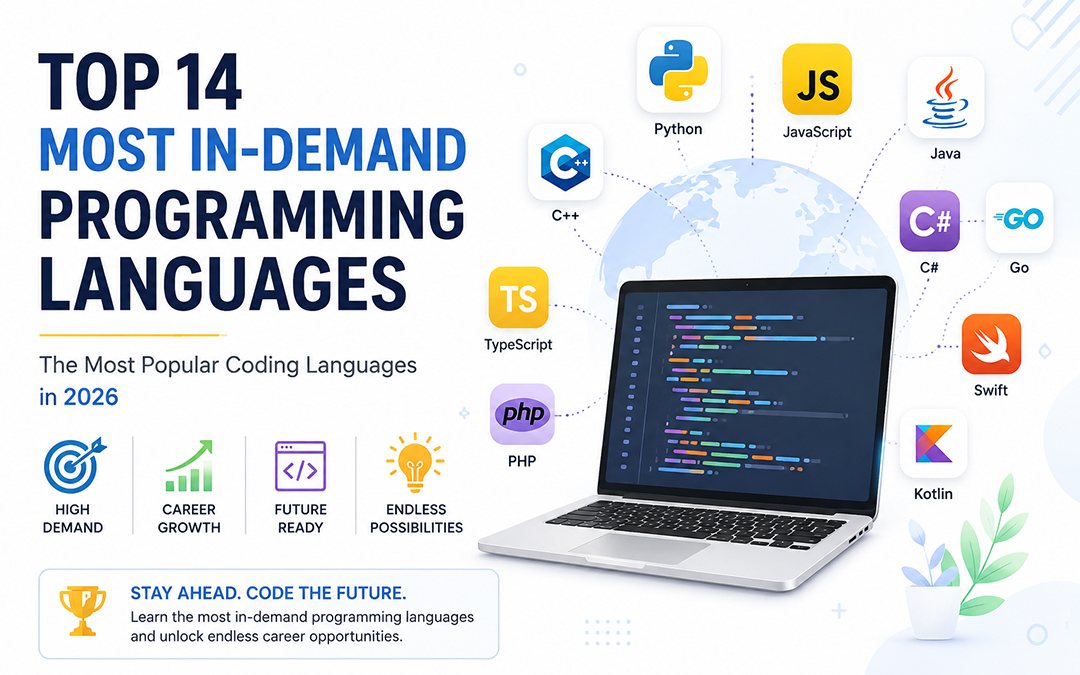
What makes them special? A lot of technology companies around the globe make operating systems, applications and games using these computer languages. By learning any of these popular coding languages, you are bound to advance your skills as a coder and increase your chances of landing a tech-related job.
The global technology job market in 2026 is being driven by three key trends: the rise of AI agents, the transition to cloud-native development, and increased emphasis on memory-safe programming practices to address security vulnerabilities in low-level code.
Based on the research conducted by Itransition, one of the most in-demand programming languages is Python, as 45.7% of recruiters prioritize Python developers. JavaScript is taking the second place with 41.5%, while Java is on the third place with 39.5%. Thus, it is evident that the choice of programming language has a considerable impact on the job market and may affect other areas such as business and recruitment.
What Is Coding?
In general, coding can be defined as writing specific computer programs or sets of programming instructions to make a computer, smartphone, or another device perform a particular task. In turn, coding languages are programming tools that allow code writers to create computer codes of different levels of complexity. Python, JavaScript, Java, C++, and many others are examples of programming languages. Computer codes created using these languages make it possible for people to do their routine tasks, play their favorite games, use various social networks, pay for their purchases online, manage their personal data, and more.
To begin with, coding is primarily about problem-solving and intellectual development. Coding Languages allow their users to write computer codes that enable smartphones, computers, and other devices to perform various tasks and make their users’ lives easier. What is more, coding is a fundamental skill that makes it possible for code writers to build successful computer businesses. It is used in a wide range of fields, from online shopping to the development of video games and artificial intelligence.
In addition, coding is the basis of all things that are done electronically nowadays. That is why it is one of the most valuable skills that is in high demand. It can be beneficial for almost any business, regardless of its size and niche. Companies and organizations can use coding to help them make their work processes smoother and more organized and offer their clients and partners superior-quality goods and services. From a personal perspective, coding is a must-know skill that allows one to increase their professional capital significantly.
Most Demanded Programming Languages by Recruiters Worldwide in 2026:
1. Python — The #1 Most In-Demand Language
Python is among the most popular and in-demand programming languages nowadays. More and more companies are using it as the multipurpose scripting language to build web apps, automate and optimize business processes, and work with data. The language is easy to learn and offers a good balance of simplicity and flexibility, allowing developers to create stand-alone apps, desktop programs, and large-scale distributed systems. Popular frameworks and tools such as TensorFlow and PyTorch, along with Python’s productivity in MLOps, contribute to the language’s dominance in the field of AI and machine learning.
Python is a favorite programming language for developers due to its readability, versatility, and less coding compared to other languages. It is a good choice for writing code faster without sacrificing performance or flexibility to build modern, large-scale web apps. Enterprises are turning to Python for cloud solutions and artificial intelligence to stay ahead of the curve.
Key Highlights:
- More than 45% of recruiters actively look for Python developers.
- Holds approximately 22% market share in the TIOBE Index (2026).
- Preferred for AI, machine learning, automation, data analytics, scripting, and web development.
- Easy to learn, highly scalable, and supported by one of the largest developer communities worldwide.
Why Python Is So Popular in 2026
Python is rising in the world due to Python’s ability to power many of the latest innovations in artificial intelligence. Many agent systems, automation frameworks, and orchestration platforms are developed with Python in mind. The programming language provides a solid ecosystem in which experienced developers can build robust applications powered by cutting-edge libraries.
Moreover, Python is often used when rapid prototyping and development are required. One can develop an application using up-to-date solutions and modern architectures and then scale it into a reliable and stable product.
Common Applications of Python
- Artificial Intelligence (AI)
- Machine Learning
- Data Science and Analytics
- Backend Web Development
- Process Automation and Scripting
With powerful libraries such as TensorFlow, Pandas, PyTorch, and many others, Python remains a driving force behind AI, data analysis, and modern software development.
2. JavaScript — The Backbone of the Modern Web
JavaScript happens to be one of the most popular programming languages in 2026. It plays a critical role in making web pages dynamic and engaging. It is the key programming language for developing websites that are interactive and responsive to users. Furthermore, with the help of Node.js, JavaScript can also be used to create amazing backend applications. All that with one programming language
JavaScript tends to be in high demand among organizations and is one of the most needed skills to have these days. In fact, millions of lines of JavaScript code are written worldwide daily to power modern responsive websites and apps that deliver an incredible experience to the end-users.
Key Highlights
- More than 40% of recruiters are actively searching for JavaScript developers.
- Trusted by tens of millions of developers around the world.
- Continues to dominate frontend and full-stack development.
Why JavaScript Is in High Demand in 2026
JavaScript remains a popular programming language due to its powerful and continuously developing ecosystem. It is the preferred language for developing backend services using such technologies as Node.js and creating virtual interfaces with React and Next.js frameworks. The latter, in particular, allows building SEO-friendly single-page applications.
In addition, JavaScript is extensively used to develop real-time applications such as video conferencing systems, group chat tools, collaborative software platforms, dashboards, and other web-based services. JavaScript frameworks are the best choice for creating websites and apps that provide users with interactive interfaces and are suitable for both small and large-scale projects.
3. Java — The Enterprise Backbone
Java remains one of the safest bets for enterprise software development, including big-scale, financial, and safety-critical applications, and systems that require a high level of security and reliability. This programming language has proved its productivity, stability, and performance multiple times, so it remains one of the most in-demand solutions for enterprises all around the globe.
The demand for Java developers is in constant growth as companies that score their security and stability the highest tend to build their software with Java, and it is usually the first choice for such systems.
Key Highlights
- More than 39% of recruiters look for Java development skills.
- Widely used across banking, fintech, insurance, and enterprise applications.
- Trusted for building secure and mission-critical software solutions.
Why Java Is Still Popular in 2026
Java’s popularity stems from its pervasiveness in the global corporate sphere and its capacity to provide high-performance computing capabilities on contemporary Java Virtual Machines. The corporate world utilizes Java to satisfy its need for reliable, scalable, and secure applications.
As a result, Java is used extensively by various sectors, including the financial industry, healthcare, insurance, and big business, to build critical software systems and enterprise-level solutions.
4. Rust — The Future of Secure and High-Performance Programming
Rust is a rising programming language of the developers’ interest due to its ability to combine the power of C and C++ languages and equip programmers with the opportunity to build memory-safe applications. The language enables developers to create “fast, reliable, and secure software” and effectively prevent common mistakes related to the management of memory.
Since its appearance, Rust has been gradually adopted as a programming language in numerous fields and areas where security, performance, and reliability are critical. Thus, the language is currently used in developing and maintaining essential infrastructure, low-level systems, and applications that require high safety levels.
Key Highlights
- Consistently ranked as one of the most loved programming languages, with 70%+ developer approval.
- One of the fastest-growing ecosystems in modern systems development.
- Designed to prevent common memory-related vulnerabilities through built-in safety features.
Why Rust Is Growing in Popularity in 2026
Rust is becoming increasingly popular due to its emphasis on high performance, reliability, and security. The language allows one to design secure programs without having to sacrifice performance, which is an important consideration for many industries. Moreover, Rust is memory safe, which eliminates certain classes of bugs and vulnerabilities completely, further increasing its appeal for applications that require a high level of security. Finally, there is a growing need for expertise in the language due to its rising adoption in several cutting-edge fields, such as blockchain development, cybersecurity, and performance-critical systems.
Common Use Cases
- Systems Programming
- Blockchain Development
- Security-Critical Applications
- Infrastructure and Performance Tools
5. C++ — The Powerhouse for High-Performance Applications
C ++ is one of the leading programming languages in terms of performance, as well as the closest to hardware. It is used in all sectors where speed, efficiency, and the ability to directly control available resources are critical: from the most challenging AAA games, robotics, and high-tech devices to high-frequency trading systems.
While C ++ has been around for a while, it continues to be popular among developers because of its unparalleled speed and versatility. Many large-scale systems and applications are written in C ++ due to their extreme performance requirements.
Key Highlights
- Maintains approximately 8–9% share in the TIOBE Index.
- Used across millions of production applications and open-source projects worldwide.
- Provides powerful control over system resources and hardware-level operations.
Why C++ Remains Relevant in 2026
C++ is a programming language that continues to enjoy popularity due to its prevalence in enterprise software and the promise of high performance. Companies are willing to invest significantly into C++ because there is little point in attempting to rewrite critical legacy systems in a different language.
High-performance applications require development with C++ due to the language’s excellent tools, frameworks, and overall reliability.
Common Use Cases
- Game Engine Development
- Embedded Systems
- Robotics and Hardware Programming
- Real-Time and High-Performance Applications
6. Go (Golang) — A Leading Language for Cloud and Modern Infrastructure
Go, also referred to as Golang, is increasingly used to build cloud-native applications, backend services, microservices, and DevOps tools. The language is designed by Google and has features that allow developers to create efficient software in terms of concurrency and execution speed while maintaining readability and a productive ecosystem.
The programming language is adopted by organizations as their primary development language due to its ability to address the characteristics of distributed systems better than other languages. Go is a general-purpose language, but it has specific solutions for developing cloud-native applications that are modular, observable, scalable, and performant. Therefore, the language is used more in development teams as the need for distributed systems and cloud-native applications grows.
Key Highlights
- Used in a growing number of backend and infrastructure projects, with adoption reaching around 10–12%+ in relevant development areas.
- Increasingly preferred by companies building large-scale distributed systems.
- Offers a strong balance between performance, simplicity, and operational efficiency.
Why Go Is Popular in 2026
I think Go remains a popular programming language due to it being heavily tied to the cloud computing space and the way the language supports concurrent processing through goroutines, thus making applications that have to process lots of data both reliable and efficient.
The language is also seeing increased usage in the development of cloud services, containers, and other infrastructure-heavy fields, which makes it a good choice for programmers who want to get involved in these areas and contribute to their growth.
Ideal Use Cases
- Cloud Computing Applications
- Microservices Development
- DevOps and Infrastructure Tools
- Distributed Systems
7. TypeScript — The Modern Standard for Scalable JavaScript Development
In general, TypeScript has become the programming language of choice for large-scale JavaScript application development. By adding static typing and development features, it allows developers to write better code, catch bugs early during development, and improve code quality. Thus, it has become even more popular among developers who build large-scale enterprise-level apps.
Today, more and more companies are choosing TypeScript as the core programming language for their development needs. It has a very high level of tooling and ecosystem support, including first-tier frameworks. It can be used in both frontend and backend development and is compatible with most JavaScript code.
Key Highlights
- Around 25–30% of recruiters actively seek TypeScript development skills.
- Used by 40%+ of developers worldwide.
- Increasingly adopted for enterprise-level web applications and full-stack projects.
Why TypeScript Is Growing in 2026
TypeScript is becoming increasingly popular because more and more companies are moving from pure JavaScript to a more reliable and consistent language. Its features enable organizations to develop applications faster and with fewer errors.
This is achieved through a better debugging process and by providing extra features that make working in an integrated development environment (IDE) easier. TypeScript is being used in both frontend frameworks and Node.js backend applications and has become a vital element in any modern application.
What TypeScript Enables
- Improved Code Maintainability
- Early Detection of Programming Errors
- More Reliable and Scalable Frontend Development
- Stronger Full-Stack Application Architecture
8. C# — A Reliable Choice for Enterprise and Game Development
C# is one of the programming languages that are actively used in the .NET ecosystem. It can be assumed that Microsoft has invested significantly in ensuring its development and popularity among the wider programming community. C# continues to be the most widespread language across the enterprise space and is actively adopted by Microsoft in its own products, including Unity, one of the most popular game engines, and the Azure cloud platform.
Microsoft’s ongoing improvement of the .NET platform allows it to provide its customers with high-quality enterprise-level applications and services. In addition, the language’s popularity ensures that there is a sufficient supply of qualified professionals who can develop and maintain applications in C#.
Why C# Remains Popular in 2026
C# is in demand due to its dominance in enterprise-level applications and its capacity to develop scalable software solutions. Organizations utilizing the Microsoft platform actively employ the programming language to build enterprise software that meets evolving needs.
The demand for C# .NET has been consistent due to its significant role in game development, particularly when using Unity 3D, and the high demand for video games and digital experiences.
Common Use Cases
- Enterprise Software Development
- Backend Services and APIs
- Windows-Based Applications
- Game Development with Unity
For companies using Microsoft technologies, C# remains a trusted solution for developing high-quality, scalable, and future-ready software.
9. SQL — The Essential Language for Managing Data
SQL (Structured Query Language) is one of the most in-demand skills in the world of software development, as most applications today rely on data: they need to store them somewhere, query them for information, analyze them for insights, and more. Since SQL is a language, it needs to be executed in some programming environment – but regardless of what technology stack you are using in your own projects, there is always a universal solution, fit for the most widespread usage scenarios and never outmoded: SQL itself is the universal means of interacting with relational databases and the data they store.
Due to the growing importance of data in today’s information-centric world, SQL skills are in great demand and have a good prospect of remaining in demand in the future.
Key Highlights
- Used by more than 60% of professional developers worldwide.
- Required by 20%+ of recruiters across various technical roles.
- Considered a fundamental skill for software development and data-related careers.
Why SQL Remains Important in 2026
SQL is essential in back-end development, data engineering, and business intelligence, as it is used to build systems that create, store, manage, and represent data. Companies utilize SQL to design data pipelines, maintain data warehouses, generate reports, and ensure proper database functioning.
Therefore, SQL is an indispensable skill for developers who engage in modern data-driven applications and technologies.
Essential Use Cases
- Database Management
- Data Analytics and Business Intelligence
- Backend Development
- Data-Driven Applications
- Query Optimization and Performance Tuning
10. HTML — The Foundation of Every Website
Although HTML (HyperText Markup Language) is not a traditional programming language, but it remains an essential element of any web development. It describes the structure of web pages, allowing browsers to display text, graphics, links, forms, and other objects correctly.
Key Highlights
- Used by approximately 96% of websites worldwide.
- Used by around 63% of developers.
- Considered an essential skill for every web developer.
Why HTML Remains Important in 2026
Despite the existence of developed frameworks and modern programming languages, HTML is an essential part of any website or web application. Knowledge of HTML is crucial to develop digital products that could be easily accessed and controlled by end-users.
Regardless of the tools used by a frontend developer, they must have an understanding of the language to build a website or web application that delivers a great user experience.
11. Swift — The Leading Language for Apple Application Development
Swift is the programming language of choice for apps running on any Apple devices, including iPhones and iPads. It is designed to be safer and faster, and it contains a variety of modern features that allow developers to create high-performance apps. Additionally, Swift is easy to learn allowing the developer to become productive and create real applications quickly.
The language is strongly integrated with Apple’s platform making it the obvious choice for developing native applications on the platform. Swift is constantly being updated and improved to deliver better performance, increased security, and a more enjoyable development experience.
Key Strengths of Swift
- Enables native application development across the Apple ecosystem.
- Features a clean, modern, and easy-to-maintain language structure.
- Delivers strong performance for client-side applications.
Swift Is Essential For
- iOS App Development
- iPad Applications
- macOS Software Development
- Apple Ecosystem-Based Applications
12. Kotlin
The majority of organizations opt for Kotlin when developing their android apps since it has overtaken Java in popularity and is used for the re-platforming of legacy apps as well as building new ones. Kotlin Multiplatform (KMP) enables sharing business logic across applications, allowing developers to create android, ios, desktop, and web apps using Kotlin.
Why it’s in demand in 2026
- Continued dominance in Android app development
- Rapid adoption of Kotlin Multiplatform for cross-platform development
- Concise, expressive syntax that improves developer productivity
- Strong backing from Google and a growing ecosystem
What makes Kotlin stand out
- Seamless interoperability with Java
- Clean, modern syntax with minimal boilerplate
- Built-in null safety and other features that reduce common runtime errors
- Excellent tooling and support for scalable, maintainable applications
13. PHP
PHP is one of the most popular server-side programming languages. It has been used for years for developing websites with various programming tools like WordPress and Laravel, and today it remains at the forefront. At the same time, PHP is not as trendy as some of the other modern programming languages. However, since the popularity of PHP is still very high, job opportunities for developers who know how to build web apps using this programming language are numerous.
Why it’s still in demand in 2026
- Powers a large share of the web, including WordPress and other CMS platforms
- Strong demand for maintaining, modernizing, and securing existing applications
- A mature Laravel ecosystem that supports rapid web application development
- Cost-effective choice for building scalable business websites and web services
What makes PHP stand out
- Excellent for CMS-driven websites and e-commerce platforms
- Ideal for maintaining and upgrading legacy applications
- Fast development with frameworks like Laravel
- Proven reliability for business-critical web applications
14. Ruby
Ruby is typically selected by start-ups and product-led companies due to its focus on programmer happiness and productivity. By using ruby and ruby on rails, developers can design, develop and launch products faster; ultimately supporting the creation of more frequent iterations and releases.
Why it’s still relevant in 2026
- Accelerates MVP development and product iteration
- Convention-over-configuration approach speeds up development
- A mature Rails ecosystem with a rich collection of libraries and tools
- Continues to power many successful startups and established web applications
What makes Ruby stand out
- Excellent for rapid web application development
- Ideal for startups, MVPs, and agile product teams
- Clean, readable syntax that enhances developer productivity
- Strong community support and a well-established ecosystem
The Rising Star: The “Dark Horse” Language
15. Mojo & Carbon
As the development of software is proceeding, new programming languages mask some of the shortcomings of their predecessors. Mojo and Carbon are such programming languages offering new capabilities and modern syntax to achieve better performance than their predecessors.
Mojo aims to combine the convenience of Python-like syntax with near-C level performance by being used in AI, machine learning, and other domains. On the other hand, Carbon is supposed to be a programming language being positioned as a successor to C++ as a safer and more maintainable language that can interoperate with existing C++ code.
Why they’re worth watching in 2026
- Focus on solving performance and scalability challenges
- Designed with modern software engineering practices in mind
- Growing interest from developer communities and early adopters
- Potential to influence the future of systems programming and AI development
Reality check
- Both languages are still in the early stages of adoption
- Enterprise usage remains limited compared to established languages
- Best suited for experimentation, learning, and evaluating future opportunities rather than replacing production stacks today
Which Programming Language Should You Learn?
Choosing the right programming language is determined not by the trends and popularity. It depends on the goals, the interests, and the software category that the future programmer will develop using this language. Every programming language is developed for a particular purpose; some are designed to create artificial intelligence systems, web applications, cloud technology, mobile and enterprise-level software, etc.
Therefore, if the reader intends to learn how to code, he/she should invest time in learning one of the languages first and then move on to the next one. In this case, the learning process will be more effective and will allow him/her to better understand programming in general and further advance his coding skills.
Quick Recommendations by Career Goal
| Career Goal | Recommended Languages |
|---|---|
| Beginners | Python, JavaScript |
| Artificial Intelligence & Machine Learning | Python |
| Web Development | JavaScript, TypeScript, HTML, SQL |
| Backend Development | Java, Go, Python, C# |
| Enterprise Software | Java, C# |
| Cloud Computing & DevOps | Go, Python |
| Systems Programming | Rust, C++ |
| Mobile App Development | Kotlin (Android), Swift (iOS) |
| Data Science & Analytics | Python, SQL |
| Game Development | C++, C# |
| CMS & Web Applications | PHP |
| Startups & MVP Development | Ruby, JavaScript |
Ultimately, there is no best programming language, but each person has their own best programming language. If you want to create AI applications, learn Python; if you want to develop Web platforms, learn JavaScript, TypeScript, or Dart; for enterprise-level systems, study Java or C#; and if you want to develop cloud-based applications, learn Go. In any case, it is better to learn one programming language and master it than to know several at a level of one.
FAQs About the Most In-Demand Programming Languages in 2026
Which programming language is most in demand in 2026?
What are the best programming languages to learn for getting a job?
Which programming language is best for beginners?
Is Java still worth learning in 2026?
Is JavaScript still relevant in 2026?
Should I learn TypeScript instead of JavaScript?
Which programming language is best for AI and machine learning?
What programming language is best for mobile app development?
Which programming language pays the highest salary?
Is Rust replacing C++?
Is PHP still worth learning?
Why is Go becoming so popular?
Is SQL considered a programming language?
Are HTML and SQL programming languages?
What is the easiest programming language to learn?
Which programming language is best for cloud computing?
Are emerging languages like Mojo and Carbon worth learning?
How do I choose the right programming language to learn?
- AI & Machine Learning: Python
- Web Development: JavaScript, TypeScript, PHP
- Mobile Development: Kotlin, Swift
- Enterprise Software: Java, C#
- Cloud & DevOps: Go
- Systems Programming: Rust, C++
- Data & Analytics: SQL, Python
Focusing on one language first and mastering its ecosystem is generally more valuable than learning multiple languages at a basic level.