
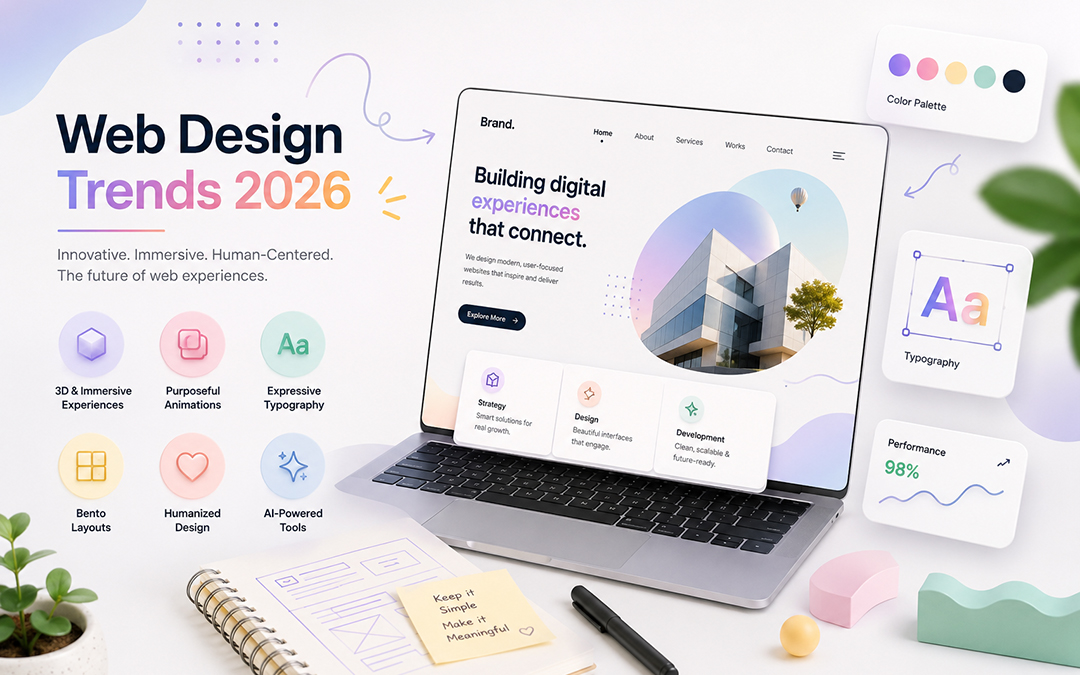
AI, immersive graphics, and greater approachability and humanization of websites are all big trends in web design right now. People are growing weary of all websites having the same appearance at the same time. Simple layouts still remain popular but more designers are getting creative with layouts that are simple and clean. To ensure that a website doesn’t become lost in the background, we’re seeing some much more daring selections in fonts, layouts and fluid animations.
Read on to learn:
- 39 key Web design trends
- 3 AI-assisted Web design trends
- Why these trends matter
Trend 1: Immersive 3D & Spatial Interfaces
Three dimensional graphics are now a common standard feature in premium websites. Immersive product displays, hover effects, floating elements, and interactive 3D models are all methods brands can use to make unforgettable experiences. With the new developments in WebGL technologies and browser performance, 3D experiences are more accessible and fluid than ever before.
Why it matters:
- Improves user engagement
- Creates immersive storytelling
- Makes products easier to visualize
- Strengthens brand identity
Trend 2: Purpose-Driven Motion Design & Animation
Animations in 2026 are animated for the purpose of guiding users through the interface, but not for decoration. Purpose-driven motion makes things easier to use by keeping focus, validating actions, and creating seamless transitions.
Common examples include:
- Animated buttons
- Scroll-triggered effects
- Loading animations
- Interactive illustrations
- Smooth page transitions
Trend 3: Softer Edges and “Liquid Glass” Shading
Shiny, transparent surfaces are taking the place of sharp corners in rounded elements. Inspired by Glassmorphism, Liquid Glass develops sophisticated and futuristic interfaces by combining delicate reflections, soft gradients, and blurred backgrounds.
Benefits include:
- Premium appearance
- Better visual hierarchy
- Modern aesthetic
- Improved depth perception
Trend 4: Bento Stacking
This layout is an arrangement of text on smaller cards in the shape of modules inspired by Japanese bento boxes. Bento layouts generate pleasing proportions that improve readability, replacing traditional grids.
Best used for:
- Portfolio websites
- SaaS platforms
- Dashboards
- Product showcases
- Landing pages
Trend 5: Digital Scrapbooking
Digital scrapbooks are creative, featuring layered textures, handwritten notes, stickers, tape effects, ripped paper edges and mixed media images. It ensures that online interactions are personal and special.
Ideal for:
- Creative agencies
- Fashion brands
- Personal portfolios
- Lifestyle websites
Trend 6: Node-Based AI Design Tools
The design process is changing due to artificial intelligence. Using visual processes rather than manual coding, node-based AI technologies enable designers to automate repetitive tasks, produce layouts, produce graphics, and construct prototypes.
Advantages include:
- Faster design iterations
- Increased productivity
- Better collaboration
- Intelligent automation
Trend 7: Retro, Brutalist & Imperfect Aesthetics
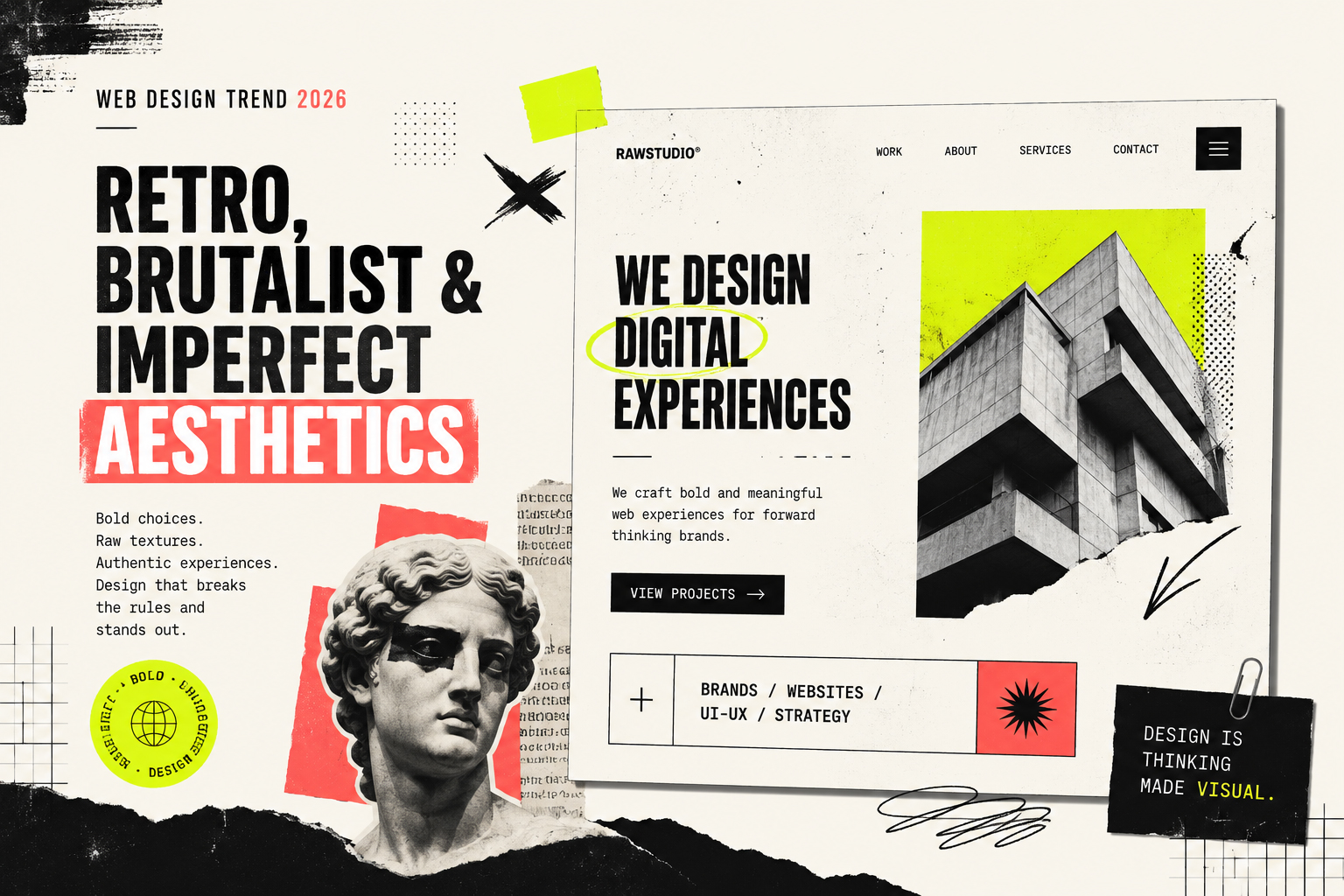
Roughed-up designs are taking the place of perfectly sheared websites. Retro fonts, retro layouts, apparent grids, bold colors, and odd layouts are all techniques that can help brands stand out from overly generic websites.
This trend communicates authenticity, creativity, and confidence.
Trend 8: Humanized and Imperfect Letterforms
The expressiveness of typography is growing. Use of hand-drawn styles, irregular spacing, and organic letterforms that seem more accessible and human than geometric typefaces are being used by designers.
These fonts add personality while strengthening brand identity.
Trend 9: Neo-Minimalism & Micro-Maximalism
2026 balances simplicity with moments of visual excitement.
- Neo-Minimalism Emphasizes:
- Clean layouts
- Ample whitespace
- Limited color palettes
- Simple navigation
Micro-Maximalism features discreet, eye-catching graphics, colorful illustrations, and expressive typography, which don’t intrude on the interface.
Trend 10: Emotion-Led, Humanized Design
Authentic brands evoke an emotional response in the consumer. To build trust, realistic imagery, storytelling, conversational language and narrative are more common on websites.
Human-Centered Design Focuses On:
- Emotional connection
- Accessibility
- Inclusivity
- User comfort
Trend 11: Vibrant Color Systems & Chromatic Expression
To provide unforgettable digital experiences, designers are adopting vibrant color schemes, dynamic gradients, neon accents, and dramatic combinations.
Popular Choices Include:
- Electric blues
- Neon greens
- Warm oranges
- Deep purples
- Multi-color gradients
Trend 12 Anti-Polish & Raw Authenticity
Honesty is always valued by customers. In order to appear more authentic and relatable, brands are purposefully utilizing natural textures, handwritten materials, flawed layouts, and raw photos.
This trend works especially well for startups, creators, and lifestyle brands.
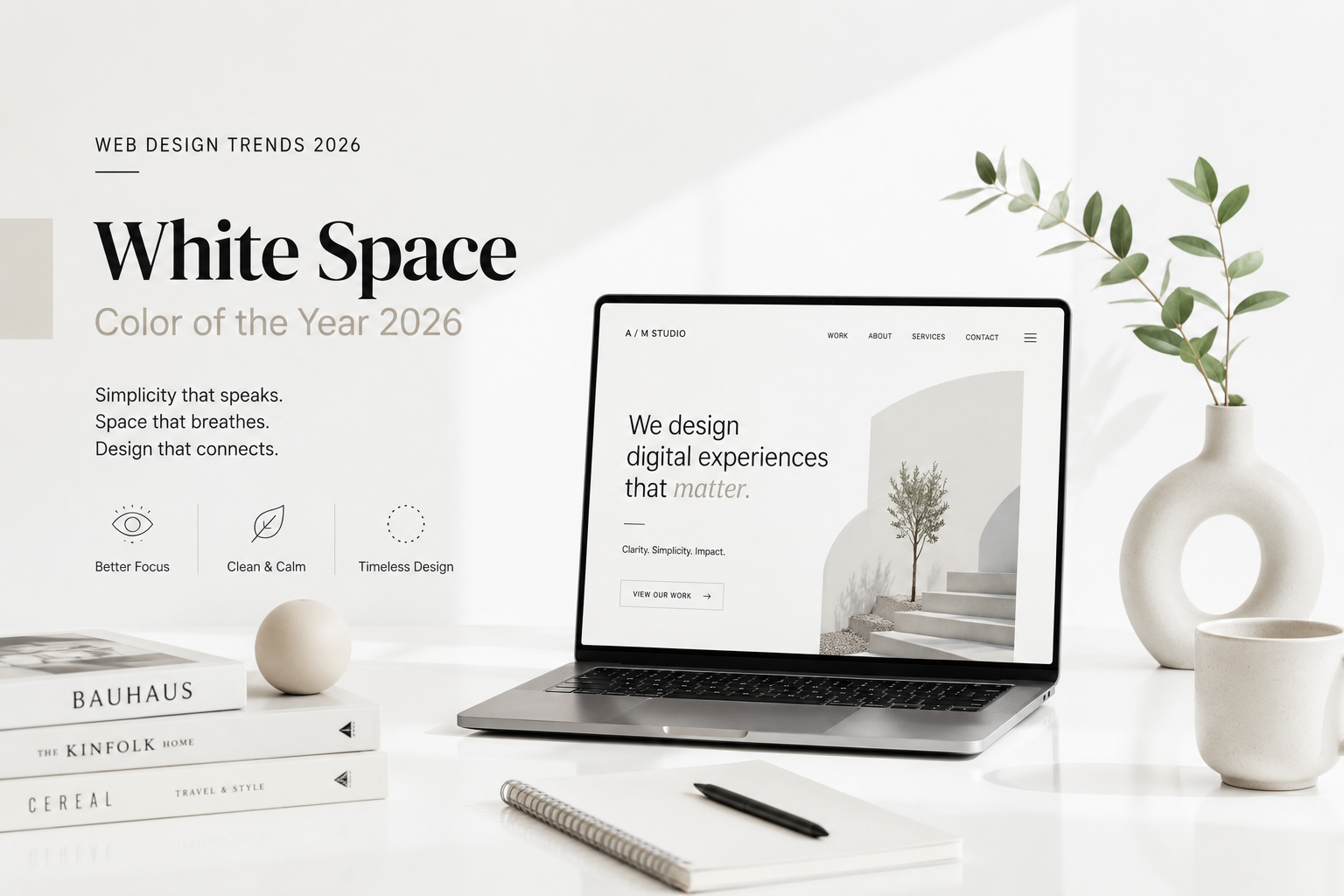
Trend 13: White Space – Color of the Year 2026
One of the best design tools: Still Whitespace. Designers use large spacing to create an easy-to-read, easy-to-concentrate, and overall better user experience.
Benefits Include:
- Better content hierarchy
- Faster scanning
- Reduced cognitive load
- Elegant presentation
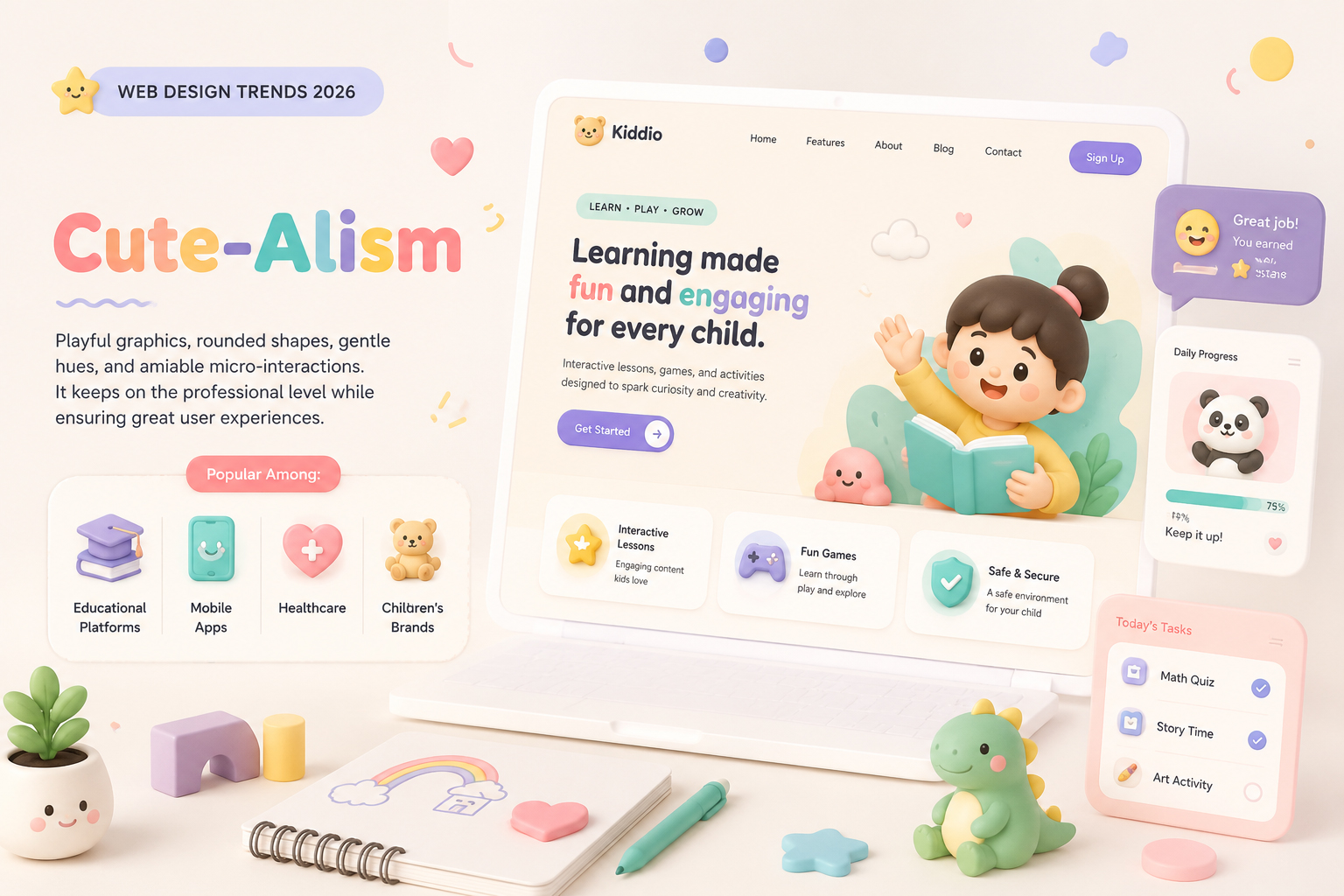
Trend 14: Cute-Alism
All these come in cute- alism – Playful graphics, rounded shapes, gentle hues, and amiable micro-interactions. It keeps on the professional level while ensuring great user experiences.
Popular Among:
- Educational platforms
- Mobile apps
- Healthcare
- Children’s brands
Trend 15: Dial-Up Delight
The idea is to bring back the old websites with some pixel art, retro icons, old school animations, and interactive fun.It is based on the early internet’s legendary retro interfaces.
It appeals strongly to Millennials and Gen Z audiences.
Trend 16: Resonant Stark
Bold contrasts, dramatic layouts, oversized typography, and messaging that’s focused are all elements of strong design Resonant Stark appreciates. Instead of overwhelming the visitors, it is simple in making a statement.
Trend 17: Frosted Touch
Frosted glass effects continue evolving with subtle transparency, blurred backgrounds, and layered interface components that create depth while maintaining readability.
This style feels elegant and futuristic.
Trend 18: Light Skeuomorphism
Light Skeuomorphism sets itself apart from previous heavy skeuomorphic designs by using a few realistic textures and soft shadows, without making the user feel like they have to use an outdated interface.
Trend 19: AI-Powered Personalization
By leveraging AI-driven design personalization, websites can create unique user experiences that reflect individual behaviors, preferences, geographical location, and browsing history.
Examples Include:
- Personalized recommendations
- Dynamic homepage content
- AI chat assistants
- Smart search
- Adaptive interfaces
Trend 20: Snug Simple
Snug Simple- focuses more on comfort and usability with round corners, soothing color schemes, big buttons and user-friendly layouts to minimize UX friction.
The main goal is to make websites feel welcoming and easy to use.
Trend 21: Human Scribble
Hand-drawn arrows, circles, highlights, and sketches are added and help to direct the user, and provide a sense of personality, appearing natural and simple. These nuanced aspects create interfaces that are not as robotic and more welcoming.
Trend 22: Experimental Navigation
Floating menus, horizontal scrolling, immersive page transitions, gesture-based interaction and unconventional layouts are all examples of ways that navigation is getting more creative.
Designers are balancing innovation with usability to create memorable journeys.
Trend 23: Bold Typography
Many websites now have typography as the primary visual element. Expressive fonts, oversized headlines and dynamic text layouts stand out immediately, and help to strengthen your brand identity.
Trend 24: Dark Mode
Dark mode is still one of the most popular user features desired. In addition to eye protection in low light, it also looks sleek and modern, and enhances battery efficiency on OLED displays.
Trend 25: Gamified Design
Gamification involves using elements such as achievements, progress bars, quizzes, rewards, badges, and interactive challenges to engage website users.
Benefits Include:
- Higher engagement
- Increased conversions
- Longer session duration
- Improved customer loyalty
Trend 26: Neumorphism
Neumorphism uses shadows and highlights to create elements that appear to be pulled out of the screen. The idea is to make elements look like they are coming off the computer screen and hovering away from the background.
When used carefully, it produces elegant, modern user interfaces.
Trend 27: Retrofuturism
Retrofuturism is a mix of past and future aesthetics. Gradients, metallic colors, neon lights, and other design elements from different eras can be combined to create a collage of various times.
Trend 28: Maximalism
Minimalist designs are not the only popular trend anymore because maximalist web pages are the opposite of minimalist ones. The former uses color, contrast, and other design elements to make a web page remarkable and engaging.
Trend 29: Collage
Collage design is an art made from combining photographs, drawings, and other images with text, textures, handwriting, and many other elements.
This trend adds creativity, storytelling, and artistic expression to modern websites.
Trend 30: Sustainable Web Design
A strategy for building web services that is informed by human and environmental wellbeing is known as sustainable web design. These services provide goods and information that are true to the Sustainable Web Manifesto’s principles of being clean, efficient, transparent, honest, regenerative, and resilient.
Sustainable Design Improves:
- Website performance
- SEO rankings
- Accessibility
- User experience
- Environmental impact
In 2026, there will be better tools, higher standards, and new ways for websites to engage real people. There are no checkboxes. Trends are opportunities to rethink the possibilities for your website.
Most importantly, these opportunities are within reach. Website builders of all levels can turn these opportunities into one-of-a-kind experiences with the right tools. That is the goal of Elementor. To provide you with a space to arrange, create, manage, and grow. A real partner in shaping the future of the web.
Trend 31: Organic Shapes, Gradients, And Anti-Grid Layouts: Humanizing Digital Aesthetics
Design is growing more organic, as it sheds the rigid gridding and severe minimalism of the last decade. The digital world is becoming friendlier and more playful, as it embraces gentle gradients, rounded edges, and flowing forms. In striving to capture this sense of life, anti-grid layouts create a pleasing rhythm that breaks up the rigid conformity of the last ten years. We see a welcome trend toward humanization, and a demand for warmth in our computers.
The use of organic forms and dynamic layouts enables sites to feel different from one another, and to feel like something – to have a certain panache. In using subtle gradients, masks, and an eye for asymmetry, one can achieve an endearing informality which communicates innovation to the user. In fact, it provides brands with an approachable face.
Trend 32: Agentic Web Experiences: Websites That Act For You
The definition of designing is changing with the advent of AI. One of the most fundamental aspects, “static” layouts, no longer dominates web creation. Web creators are now building “agentic” experiences, which involve responsive and adaptive designs. The new generation of artists is building intelligent systems that blur the lines between function and design.
Websites can now be dynamic and transform both the presentation and substance of the material. Designers can give their sites logical underpinnings instead of hard-coding each variation. Web developers can make their pages both perform and adapt to specific segments of their audience. The changes will happen in real-time with minimal intervention from the creators. Artificial Intelligence would handle the “how” and “what,” while developers focus on the “why.”
Trend 33: From Prompt To Partner: AI As Your Creative Co-Designer
AI is changing from a content producer to a reliable creative companion. By 2026, the programs will be able to offer design recommendations, suggest ways to make websites more accessible, optimize the layout based on artificial intelligence, improve fonts and colors, and even drive chatbots that provide conversation design software with online users. Some programs already offer automated A/B testing that can recommend the best design choices.
Therefore, the creators are no longer passive, waiting for suggestions from chatbots and only implementing changes. Instead, using WordPress plugins or design tools with AI assistance, they collaborate in real-time with an AI to develop ideas.
Trend 34: Design Tokens: The Scalable Language of Modern Websites
The design systems on the web are becoming increasingly scalable and rely on design tokens to a growing extent. These design tokens basically allow designers to store their information as design systems in the form of variables rather than hard-coding specific values each time they need them. These design tokens provide designers with meaningful names that help unify their team’s lexicon and achieve scalability and theme consistency. This way, for large businesses that have to manage multiple brands at once, one single token can be used to make changes to all the necessary websites, ensuring that there are no mistakes and inconsistencies in the processes. This also means that the handoff to customers and developers is much smoother and less error-prone for agencies and independent professionals. All-in-all, the design tokens provide design systems with more scalability and flexibility, bringing the design closer to the web development process and uniting the two fields.
Trend 35: Micro-Interactions And Motion Design: Function Over Flash
Animation is one of the critical aspects of usability in 2026. Micro-interactions are great for emphasizing feedback loops, drawing attention to tappable areas, and generally making the complex UI understandable. In this context, animation is part of functional design – motion serves to clarify, not distract from the content. Of course, animation done wrong makes the site hard to use and slows the user down – but a skillful transition reduces the cognitive load and helps to focus on the content. The main challenge in animating web products in 2026 is not rejecting animation in principle but, on the contrary, constantly thinking about its implementation.
Attention should be paid to transitions between screens, states of interactive elements, and animations triggered by a hover. All of the above will allow to increase usability. For maximum effect, animation can be used to create an immersive experience – using perspective and parallax effects, not extreme 3D. Animations can be created using V4-Transform & Transitions and designed so that their appearance and behavior are controlled precisely. The next level of animation will be working with atomic transitions – that is, coordinate motions of all the necessary elements so that the design looks smooth and the user is not distracted by animation but focuses on content. Animation will be part of the design process and will be carefully considered by designers – transitions must be meaningful and serve a specific purpose.
Trend 36: Hyper-Personalized Web Journeys: Every Visitor, a Unique Path
First-name addressing in emails is no longer a novelty. In 2026, the user expects that the website will remember and respond to his or her history and preferences in real-time. Personalization is the new standard; whether it is manifested in adaptive menus, tailored landing pages or product recommendations. The latest AI developments allow to make websites more personalized for each client on the fly, adjusting to their roles and behaviors in real-time and building an experience specific to each visitor. The design of a site is no longer a one-size-fits-all, as a contextual web personalizes itself depending on the visitor and his or her needs at a particular moment.
Personalization helps to build engagement and loyalty and ultimately drive conversions. It puts the user first and makes him or her feel valued and understood. Nevertheless, the task of maintaining trust and a strong balance between privacy and personalization is complicated.
Trend 37: Brand Experience Through Storytelling: Websites That Build Trust
Trust signals and connections are more significant than ever in a competitive digital landscape. The way for brands to stand out from the crowd is through brand storytelling. Websites can offer engaging brand experiences and go beyond simple informational exchange by combining imagery, animation, interactive content, and video storytelling. The websites give the brands a chance to tell a story that will touch their customers’ hearts and minds rather than provide a brief description. This shift reflects the larger trend in UX design to create experiences that are engaging and emotionally intelligent. The focus is on the emotional connection and involvement rather than on the mere delivery of information. In other words, the brands that provide the most comprehensive storytelling will rule the market.
Moreover, compelling narratives build brand affinity, which means that they help build brand equity and customer loyalty. A company that manages to engage its clients will be able to turn them into brand evangelists. Thus, through storytelling, the brands can position themselves as trustworthy and desirable destinations. The customers can connect to brand storytelling on a personal level in ways that other types of design cannot facilitate.
Trend 38: Accessibility As Creative Default: Design for Everyone
In 2026, inclusive design is no longer a consideration for the end but rather an integral part of the design process. Accessible design is a necessity, driven both by the passage of laws such as the European Accessibility Act and a general shift in culture towards greater acceptance and tolerance. International standards such as the Web Content Accessibility Guidelines (WCAG) play a role in this growth, as do factors such as the increase in overall color contrast and better arranged content helping to generally improve the experience for all website visitors.
Creating inclusive digital experiences will make brands more trustworthy to a larger audience, reducing risks due to potential lawsuits and building better relationships with customers in the long run. Most importantly, it shows that a business cares about all its visitors and customers. And when it comes to responsive design and the use of tools such as ARIA, accessibility is no longer nice to have but rather an inherent characteristic of good design.
Trend 39: Sustainable & Ethical Web Design: Better for People, Better for The Planet
The impacts of digital activities on the environment are becoming increasingly evident, and since each page view requires energy, eco-friendly hosting and sustainable websites are becoming a necessity. To reduce the environmental footprint of their activities, many artists are integrating carbon-conscious design principles into practice. Sustainability in creative industries is inextricably linked to ethical web design: reducing data, privacy-by-design approaches, ethical UX/UI practices, and transparency. Moreover, brands that do not transition to ethical design practices risk losing customers who now consider sustainability and ethics to be a priority.
.Therefore, developing an eco-conscious website is a responsible and ethical choice. Webs that use clean code and light algorithms are more likely to rank higher in search engine results, attract more traffic, and reflect well the ethical positioning of the brand. In addition, thoughtful and ethical data practices will reduce the risks and increase the trust and loyalty of the customer.
AI Web Design Trends
Web design is undergoing a significant improvement under the impact of artificial intelligence. Sites that used to be global and uniform are now changing dynamically depending on an individual’s personal preferences due to the personalization factor. In addition, sites are optimized for performance and speed. By simplifying the design and using accordion-style drop-downs for lists, designers make sites appear clean and intuitive for customers while at the same time optimizing the material for faster loading speeds and easier reading by robots.
AI trend 1: Chatbots
Discuss how AI chatbots differ from traditional chatbots. Describe how AI chatbots are being used to improve the experience of navigating a website. Explain how the new chatbots allow more control to the user by performing various tasks for them
Traditional chatbots have been notoriously ineffective, taking on the form of phone trees that sit quietly in the corner of the webpage, waiting for a specific set of inputs from the user, and then giving very broad responses, making any sort of meaningful interaction impossible. With AI, chatbots are able to move past this limitation in a major way. The user is no longer confined to a small set of responses, and they get dramatically better results in comparison to older chatbots. With this improvement, chatbots are now being utilized as navigational tools for some websites, allowing the user to more dynamically interact with the website, and even perform tasks such as booking appointments, or finding relevant products and services. Rather than making the user jump through hoops to get a quote or to get to the specific page they are looking for, the chatbot can take specific actions to help the user achieve their goal, and even allow the user to book appointments or ask for quotes directly within the chatbot itself, resulting in a much more pleasant, intuitive user experience.
AI trend 2: Voice-Activated Interfaces
Voice-activated interfaces on websites have left the era when they required a very strict structure of commands in order to open a search field. The majority of the websites are now adopting the “voice-first, but not voice-only” format, allowing the user to communicate with the interface naturally, using their speech. The user can use their natural language, while the website’s speech recognition interprets meaning, context, and intention. The most important part of the voice-first interfaces is that they allow the user to accomplish complex tasks by simply speaking the commands out loud. The visual display is only a tool to ensure the accuracy of the performed task.
The interfaces that use voice as a communication method have gone a long way since the times when a user needed to specifically and precisely articulate certain words in order to receive the desired result. Now the natural language can be used to make the website perform a certain task, such as finding the lowest prices or searching for a certain parameter in medium. The most prominent feature of the websites using the voice-first interfaces is that they allow the user to complete complex tasks that would normally take much longer and more effort. The voice becomes the tool to complete the task, while the display serves to confirm the voice input. It creates an illusion of a natural conversation between the user and the website, allowing it to become much easier and faster to navigate the website and accomplish the task.
AI trend 3: Progressive Lead Nurturing
Progressive lead nurturing online used to involve annoying your website visitors by asking them to fill out lengthy, twenty field forms as soon as they land on your website. With AI, websites can now employ progressive lead nurturing, wherein information is gathered from prospects over time rather than all at once.
The website should ask different screening questions from first-time website visitors as opposed to regulars who already give some information. It should recognize returning website visitors and ask more personalized screening or qualifying questions based on what it already knows about them. For instance, a first-time visitor might be asked to provide their first name and email address to download a helpful whitepaper. A returning visitor would then see a different form altogether that asks more specific questions such as the size of the team they work with or the challenges they are currently facing. Using this strategy, coupled with intelligent implementation of CRM and dynamic forms that change based on the information already provided, a website can engage a prospect for a long time without annoying them, allowing the prospect to move through the signing up process with ease and no hassle.
Why Follow Website Design Trends?
The website design trends are determined by the evolving needs and expectations of website visitors, emerging technologies and tools, and the preferences set by search engines. The website you launch is supposed to meet users’ expectations, provide the best online experience, and facilitate their engagement and interaction with your brand. Moreover, staying up-to-date with the design trends can help your website become more modern, mobile-friendly, optimized, and competitive.
Benefits of Following Website Design Trends:
- Improve User Experience – Modern layouts and intuitive navigation increase the convenience of website use.
- Increase Engagement – Interactive elements and beautiful design attract the attention of surfers and keep them on the page.
- Boost Mobile Performance – New standards of website design are focused on responsiveness, which means a good user experience on mobile devices.
- Enhance Brand Credibility – An up-to-date website inspires confidence and professionalism.
- Support SEO Efforts – A search engine favors fast-loading websites that provide a positive user experience.
- Increase Conversion Rates – A good user experience usually results in more inquiries, sales, and conversions.
- Stay Ahead of Competitors – A modern website is essential to make your business stand out from the competition.
- Improve Accessibility – Modern design practices make websites usable for a wider audience.
- Adapt to New Technologies – Trends often incorporate innovations that improve functionality and performance.
- Future-Proof Your Website – Regular updates help ensure compatibility with evolving devices and browsers.
Web Design Trends Faqs
How Do You Incorporate AI Into Your Web Design Process?
What Web Design Trends Improve User Experience (UX) The Most?
How Do I Decide Which Web Design Trends Are Right For My Project?
What Role Does Sustainability Play in Modern Web Design?
What Are The Top Web Design Trends To Watch In 2026?
Bring your favorite Web Design Trends To Life With Technoz Software
Keeping up with changes while designing for the Web is essential as are recognizing trends from noise. Technoz will help you make your idea come to life and shape your vision into future-proof interactive platforms and digital products. Whether you want to develop a brand new concept or rework an existing one, we have the skills and experience to do it for you!