
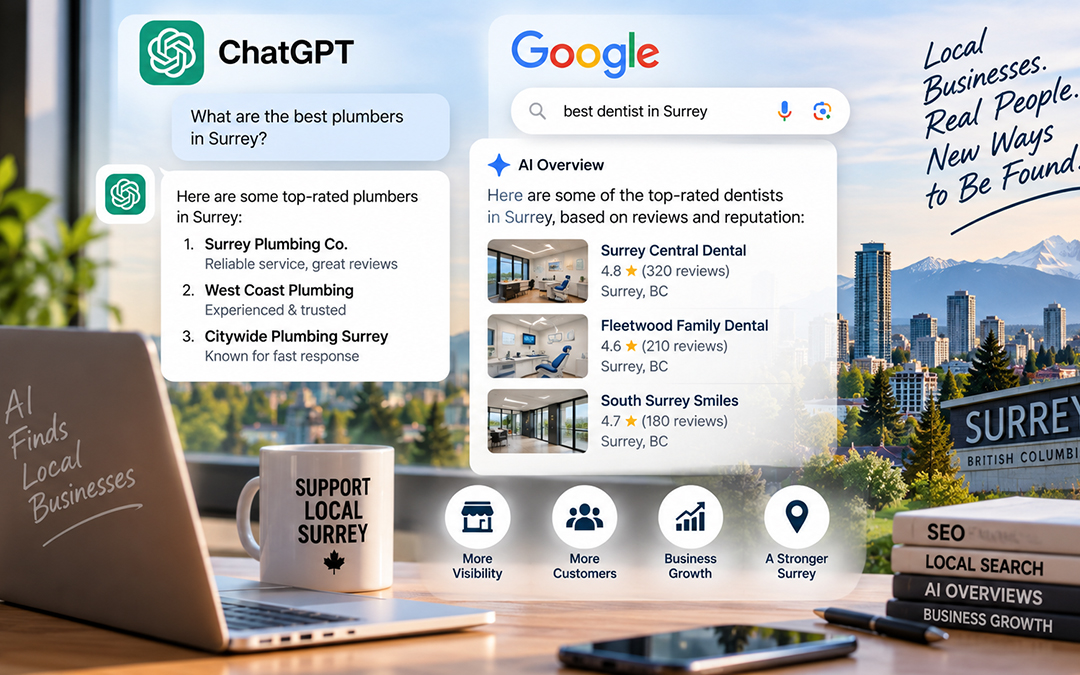
Ask a Surrey resident how they found their last plumber, dentist, or new restaurant, and there’s a decent chance the answer no longer starts with “I Googled it.” Increasingly, it starts with “I asked ChatGPT” — or the answer showed up automatically, in the AI-generated summary sitting above Google’s regular search results, before a single blue link was clicked.
This shift is subtle enough that a lot of local business owners haven’t fully registered it yet. But it’s already changing which businesses get found — and which ones quietly disappear from the conversation entirely, regardless of how good their actual product or service is.
What’s Actually Changing in How People Search
For roughly two decades, “search” meant typing a few keywords into Google and scanning a list of blue links. That’s still happening, but a growing share of queries — especially open-ended, comparison, or recommendation-style ones — now get answered directly, without the searcher clicking through to any website at all.
Two things are driving this:
- Google AI Overviews now appear above traditional results for a large share of searches, summarizing an answer pulled from a handful of sources Google’s AI judged most relevant and trustworthy. For local business queries — “best accountant near me,” “who does emergency plumbing in Surrey” — that summary is often the only thing a searcher reads.
- Conversational AI tools like ChatGPT are increasingly used the way people used to use Google: asking for a recommendation directly, in plain language, and often getting a shortlist of two or three specific businesses back, complete with a short explanation of why each one was suggested.
In both cases, visibility is achieved not via a first-page listing that a user may scroll past — but rather, by being selected, summarized, and endorsed by an algorithm on behalf of the searcher. A fundamentally different kind of visibility than #3 on the first page — and one requiring a fundamentally different set of optimizations to achieve.
Why This Matters for Local Surrey Businesses Specifically
Local service businesses are especially exposed to this shift, for a simple reason: local queries are exactly the kind of specific, decision-driving questions AI tools are best at answering directly. “Which moving company in Surrey has good reviews,” “is there a good Punjabi restaurant in Newton,” “who installs hot water tanks in South Surrey” — these are precisely the queries where a searcher wants a short, confident answer rather than ten links to click through and compare.
Surrey’s business landscape adds another layer: a dense, competitive local market spanning distinct neighbourhoods — Guildford, Fleetwood, Cloverdale, Newton, South Surrey — where businesses often compete hyper-locally as much as they compete city-wide. If an AI tool is synthesizing “the best options in Surrey” from whatever content it can find and trust, a business with thin, generic, or outdated web content is easy to leave out of that summary entirely, even if it’s a well-established local operator with excellent reviews.
The businesses currently showing up in ChatGPT recommendations and Google AI Overviews aren’t necessarily the biggest or the longest-established — they’re the ones whose websites and online presence give AI systems clear, specific, well-structured information to work with.
How AI Search Tools Decide Which Businesses to Mention
Neither Google’s AI Overviews nor tools like ChatGPT are inventing recommendations from nothing. They’re synthesizing an answer from real content they can find, parse, and trust — which means the underlying mechanics aren’t as mysterious as they first appear.
A few consistent patterns show up in how these systems choose what to mention:
- Clear, specific content beats vague marketing copy. A page dedicated to explaining the bare facts of the type of business and what it offers is more likely to be cited by an algorithm than a page using generic phrases meant to attract the attention of any nearby passerby.
- Structured information is easier to cite. It’s always good to make sure details are clear and correct when it comes to the services you offer, the area you service, the hours of operation and the prices for your goods or services. All of these details are easily pulled by algorithms and will always be used to help generate a summary about your business from potential customers.
- Consistency across the web matters. Having consistant details throughout the internet is also important as far as having your business properly indexed by search engines. Algorithms have the same kind of issues when information about your business doesn’t match up accross different platforms including your own website, Google Business, directory sites and review sites. Anywhere that information about your business might be found is a potential place for errors that could make it harder for algorithms to trust your site and properly cite your business.
- Genuine authority signals still count. Reviews and mentions from other sites about your business will always play a role on how likely a search algorithm is going to be to cite your business as well. A combination of consistant information, mentions from other sources and reviews from customers will highlight your business as a credible source for search engines and any algorithms they utilize.
In short: AI search tools tend to recommend businesses they can understand clearly and trust confidently. Businesses that are vague, inconsistent, or thin on real information online are simply harder for these systems to include, even when the business itself is excellent.
What Businesses Can Do About It Right Now
None of this requires abandoning what already works — it means extending it. A few concrete steps make a meaningful difference:
- Write content that answers real questions directly. Write content that answers real questions directly. Rather than describing your services in broad marketing language, provide plain-language answers to the specific questions customers are asking (“how much does X cost,” ‘how long does Y take,’ “do you serve [neighbourhood]”)
- Keep business information consistent everywhere. Ensure your business information is consistent everywhere. Your name, address, phone number, and service description should be identical on your website, Google Business Profile, and any other directories.
- Add structured FAQ content to key pages. FAQs are one of the clearest, most directly citable formats for both AI Overviews and conversational AI tools.
- Be specific about location and service area. Naming the actual neighbourhoods and communities you serve — rather than just “Surrey” or “Metro Vancouver” — gives AI systems more precise information to match against local queries.
- Keep review profiles active and current. Recent, genuine reviews continue to function as a trust signal that AI systems draw on, the same way they always have for traditional local search.
This is the core of what’s often called AI search optimization, or AIO/GEO (generative engine optimization) — treating AI visibility as a distinct, deliberate part of a business’s online strategy, built on top of a strong existing web presence rather than replacing it. It’s the same discipline behind Technoz Software’s SEO services in Surrey, which now build AI-search readiness into standard local SEO work rather than treating it as a separate add-on.
What This Doesn’t Replace — Traditional SEO Still Matters
It’s tempting, watching this shift happen, to assume traditional SEO is becoming irrelevant. It isn’t — if anything, it’s becoming more foundational, not less.
AI Overviews and conversational AI tools still draw heavily on the same signals traditional SEO has always been built around: a technically sound website, clear and well-organized content, genuine authority and trust signals, and strong local relevance. A business with weak fundamentals — a slow site, thin content, inconsistent listings — isn’t going to leapfrog into AI visibility through some separate trick; it’s going to struggle in both traditional rankings and AI summaries for the same underlying reasons.
The more accurate way to think about it: traditional SEO earns a business the right to be found. AI search optimization is about making sure that once found, a business’s information is clear and structured enough to actually be understood, trusted, and recommended by the AI systems now standing between a searcher and their decision.
For Surrey businesses, that means the smartest move isn’t choosing between traditional SEO and AI search readiness — it’s making sure both are being handled together, by a web development and SEO partner who understands how the two now work side by side. If your business isn’t sure where it currently stands with either, that’s worth finding out before more of your customers start their search with a question to an AI, instead of a search bar.